Bitcoin slipped below $63,000 as renewed fighting between the United States and Iran pushed oil prices higher, drove bond yields up, and revived concern that an extended disruption in the Strait of Hormuz could keep inflation elevated.
Data from CryptoSlate shows the largest cryptocurrency traded near $62,940, down about 1.4% over 24 hours. Other leading digital assets, including Ethereum, XRP, and Solana, all posted modest losses of less than 2% during the reporting period.
CoinGlass data showed that this price performance resulted in $252.9 million in cryptocurrency positions being liquidated over the previous day, with traders holding leveraged long positions accounting for most of the losses. Such liquidations occur when exchanges automatically close undercollateralized trades, often accelerating a decline as prices pass through crowded levels.
Bitcoin held up better than many Asian markets, but any idea that investors would treat it as a refuge quickly faded. It moved with the rest of the risk trade, swinging on the same rate fears that dragged technology stocks and other speculative assets lower.
 Related Reading
Bitcoin’s $60K price floor is back in play as Hormuz oil shock returns
BTC fell below $63,000 after new U.S. strikes as oil, the dollar and yields rose and equity futures retreated. Jul 13, 2026 · Liam 'Akiba' Wright
Strait of Hormuz chokepoint triggers macro contagion
The crypto market turbulence is merely a symptom of a broader macroeconomic shockwave emanating from the Middle East. Global risk sentiment fractured following a weekend of American military strikes against Iranian installations.
The conflict currently centers almost entirely on the Strait of Hormuz, a crucial maritime artery that carries roughly a fifth of all global seaborne crude oil.
The waterway's operational status remains heavily contested, creating a fog of uncertainty that energy markets traditionally despise.
On X (formerly Twitter), the US Central Command confirmed that it deployed fighter aircraft, naval vessels, and autonomous sea drones to neutralize coastal radar networks, air defense systems, and missile launch capabilities.
The American military leadership also insisted that the corridor remains open for lawful commercial navigation and characterized the recent engagements as a necessary measure to protect civilian mariners from unprovoked hostilities.
It added:
“The Strait of Hormuz is a vital maritime corridor for global trade. Iran does not control it. U.S. forces are postured and prepared to ensure that freedom of navigation remains available to commercial shipping despite Iran’s continued unwarranted aggression, harassment, threats, and arbitrary declarations.”
However, Iranian authorities vehemently disputed that narrative, claiming the strait is entirely closed to international shipping.
The diplomatic rhetoric has sharpened dramatically, with Iranian Parliament Speaker MB Ghalibaf stating that the “era of one-sided deals is over” and warning that the passage will only operate under strict Iranian administrative arrangements, firmly rebuffing any American transit ultimatums.
A prolonged closure would leave exporters with limited pipeline capacity to bypass the strait, tightening oil supply and raising freight and insurance costs.
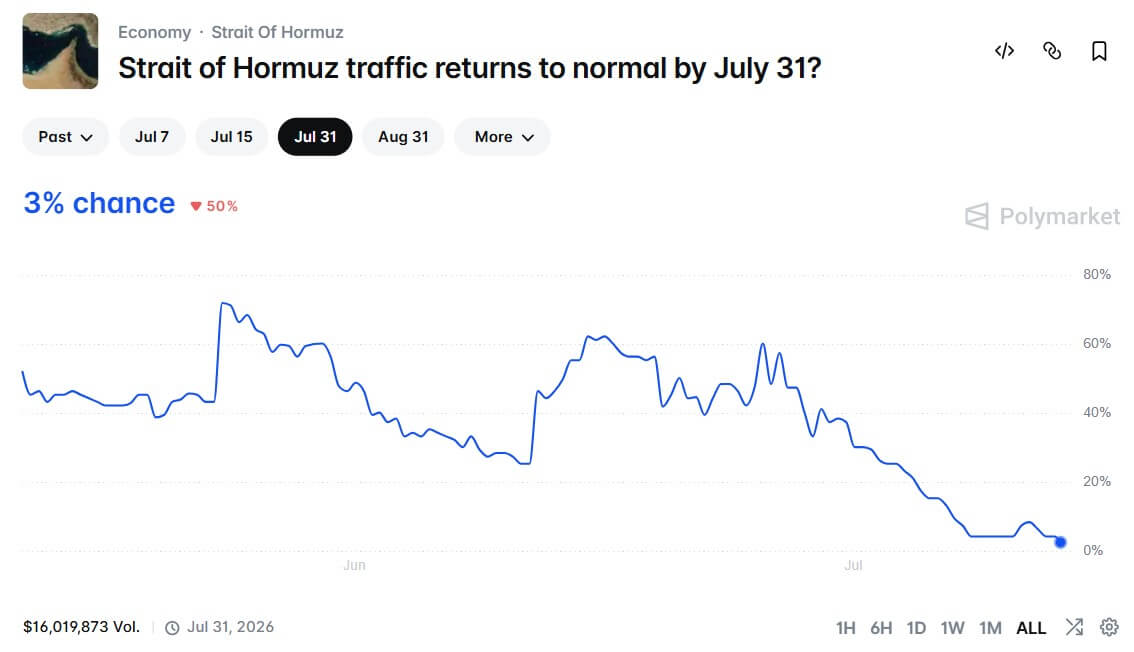
On Polymarket, traders are pricing in only a 3% chance that traffic will meet the contract's recovery threshold by July 31. The market resolves “Yes” if IMF PortWatch reports a seven-day moving average of at least 60 vessel calls on any date through July 31; otherwise, it resolves “No.” The contract had recorded more than $16 million in volume as of press time.
Oil shock revives interest-rate risk
The maritime standoff pushed oil prices higher, with Brent crude gaining as much as 4% and approaching $80 a barrel.
The increase revived concern that elevated energy costs could keep inflation above the Federal Reserve’s target and delay any shift toward lower interest rates.
For Bitcoin traders, the immediate risk is therefore not only an expansion of the conflict but also the possibility that sustained increases in oil prices alter the outlook for US monetary policy.
Higher crude prices can feed into transportation, manufacturing and consumer costs. If those pressures persist, the Fed may have less room to cut rates and could face greater pressure to tighten policy further.
Higher yields also increase the opportunity cost of holding assets that produce no income, including Bitcoin and gold, while supporting demand for the dollar and government debt.
The minutes from the Fed’s June meeting showed that a few policymakers saw a case for raising the federal funds rate, although the committee ultimately left it unchanged at 3.5%-3.75%. Officials also considered scenarios in which inflation remained elevated due to the Middle East conflict, tariffs, and strong demand driven by investment in artificial intelligence.
Markets reflected that concern Monday. The two-year Treasury yield rose to its highest level since February 2025, while futures implied about 39 basis points of Fed tightening by year-end. Gold also declined as higher yields and a stronger dollar outweighed demand for traditional havens.
That combination helps explain why Bitcoin weakened even as geopolitical risk increased. The cryptocurrency has sometimes rallied during periods of political or financial stress, but its short-term performance remains sensitive to leverage, dollar liquidity and the expected path of interest rates.
Korean chip rout leads Asia losses
The most violent reaction to the geopolitical premium unfolded across Asian equity exchanges, where an estimated $950 billion in market capitalization evaporated in a brutal trading session earlier today.
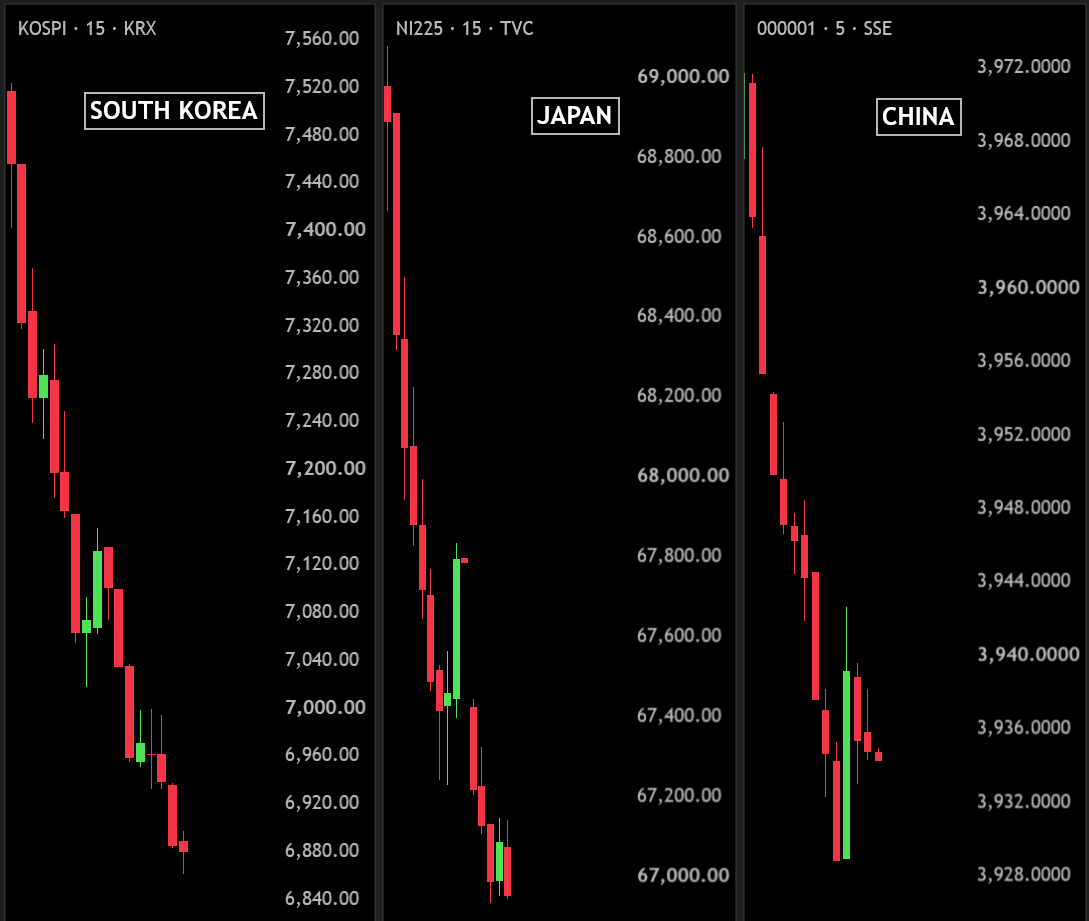
Bull Theory reported that the devastation was most pronounced in Seoul, where the benchmark KOSPI index plummeted 9.2%, erasing $377 billion in corporate value. The severity of the capital flight forced exchange operators to trigger a trading halt for the seventh time this year.
The South Korean rout was heavily concentrated in the semiconductor sector, which had previously enjoyed immense artificial intelligence-driven momentum. Memory chip behemoth SK Hynix suffered a 15% collapse, which is the steepest single-day decline in its corporate history.
The timing was particularly jarring, materializing just one trading day after the company executed a $26.5 billion public listing via American Depositary Receipts on Wall Street, marking the largest foreign debut in US market history. Shares of the semiconductor giant are now trading more than 35% below their June peak.
The sudden reversal of fortune highlights the immense volatility inherent in the current artificial intelligence hardware trade, where massive capital inflows can evaporate at the first sign of macroeconomic distress.
Industry peer Samsung Electronics was not spared, shedding nearly 11% in tandem. The broader KOSPI is now submerged 28% from its recent highs, charting its fourth consecutive week of losses.
While the index retains a 58% year-to-date gain, that figure represents a severe contraction from the 116% return it boasted earlier in the cycle.
Meanwhile, the market contagion respected no borders as it spread to Tokyo, where the Nikkei 225 surrendered 2.7%, incinerating roughly $236 billion in shareholder wealth.
Additionally, Chinese equities listed on the Shanghai Stock Exchange retreated 2.3%, translating to a $210 billion loss. Technology-heavy markets in Taiwan fell 3.1%, wiping out $127 billion, while India's Nifty index registered a comparatively modest 0.3% dip, shedding $14.7 billion.
The post Bitcoin falls below $63,000 as markets give Hormuz traffic just 3% chance to normalize by August appeared first on CryptoSlate.