Crypto’s 2026 bear market has become an industry-wide shakeout. Projects are closing, companies are winding down, and owners are retiring products across exchanges, DeFi, NFTs and infrastructure. The damage has the feel of capitulation. Bitcoin’s low still depends on demand, liquidity and positioning.
That strain reached two established exchanges this month. BitMEX and BitMart announced wind-down plans three days apart. BitMEX announced July 22 that it will end exchange services on Sept. 23. New registrations stopped immediately, new positions will be restricted from Aug. 26, and users can continue to log in and withdraw after the trading platform closes. BitMart followed July 26 with a longer wind-down: trading is scheduled to stop Aug. 26, while formal platform operations are due to end Jan. 31, 2027.
Boardrooms and trading screens keep different time. Months of thin revenue can drain a company’s runway, so the doors may close after traders have priced in the damage or before the selloff is finished. The notice tells us where one business ran out of road. Bitcoin follows the market’s clock.
Closures, restructurings and product sunsets
A recent X post compiled a list of dozens of projects, exchanges, protocols, wallets, games and analytics products under the label “shut down or disappeared in 2026.” The entries span sharply different events, causes and timelines.
| Name | What happened | Classification | Main consequence |
|---|---|---|---|
| BitMEX | Exchange services scheduled to end Sept. 23 | Full exchange wind-down | Positions must close; withdrawals continue |
| BitMart | Trading scheduled to end Aug. 26; platform termination planned for Jan. 31, 2027 | Phased exchange wind-down | Users must unwind positions and withdraw |
| Balancer Labs | Corporate entity is being wound down | Entity restructuring | Work shifts to DAO and service-provider structures |
| Polygon zkEVM | Mainnet Beta sequencer stopped July 1 | Planned network-product sunset | Users and protocols must migrate or claim assets |
| Across Protocol | Bridge remained live in July | Active protocol | ACX holders await a cash-or-equity portal |
In March, Balancer co-founder Fernando Martinelli said that Balancer Labs would wind down, citing the fallout from a 2025 exploit and the corporate entity’s lack of sustainable revenue. The Balancer protocol was set to continue, with essential work moving toward the DAO, Foundation, an operating company, and independent service providers. That event tests whether a decentralized protocol can outlive the company that incubated it.
Polygon’s zkEVM Mainnet Beta reflects product consolidation. Polygon gave roughly a year of notice before the sequencer stopped July 1, with migration and claim procedures for users. The retirement carries real user risk, particularly for funds locked in DeFi contracts, while the wider Polygon ecosystem remains in operation.
Nifty Gateway announced in January that its standalone marketplace would close as Gemini shifted NFT support into Gemini Wallet. DappRadar’s governance forum said its platform company had begun winding down in November 2025, while describing the DAO as a separate legal structure whose access to the brand and platform remained unresolved.
Across Protocol’s bridge remains live. However, a June governance update said a portal allowing ACX holders to sell their tokens for cash or exchange them for equity had been delayed by legal and operational work. The protocol is not closing, but the restructuring marks a move from its DAO-and-token model toward corporate ownership, and away from crypto’s decentralized, onchain ideal.
These are just a handful of the projects we've lost this year, but the cases show how many forms the contraction is taking. Some businesses ran out of sustainable economics. Some owners cut product lines. Some networks retired technology.
Insolvency, strategic consolidation and decentralized restructuring respond to different pressures, making the wave a sign of hostile operating conditions rather than a consistent market indicator.
Beyond those cases, the compilation names Odos Protocol, Moonbeam, Exchange Art, Ctrl Wallet, Cypher, ICON Network, NFTfi, Loopring DEX, Radiant Capital, Dmail, DL News, Tally, Step Finance, Swellchain, Redstone, JPG Store, ZeroLend, Goldfinch, Ionic, Everclear and Arkham Exchange.
It also reaches into crypto gaming and consumer products, including Pirate Nation, Nyan Heroes, Ember Sword, Wildcard, Fantasytop and Bloktopia, and infrastructure or analytics providers such as Blocknative, Parsec, TapTools and DataHaven.
Not every entry represents a full shutdown, but the breadth of the list illustrates how the contraction has spread well beyond exchanges into almost every layer of the industry.
 Related Reading
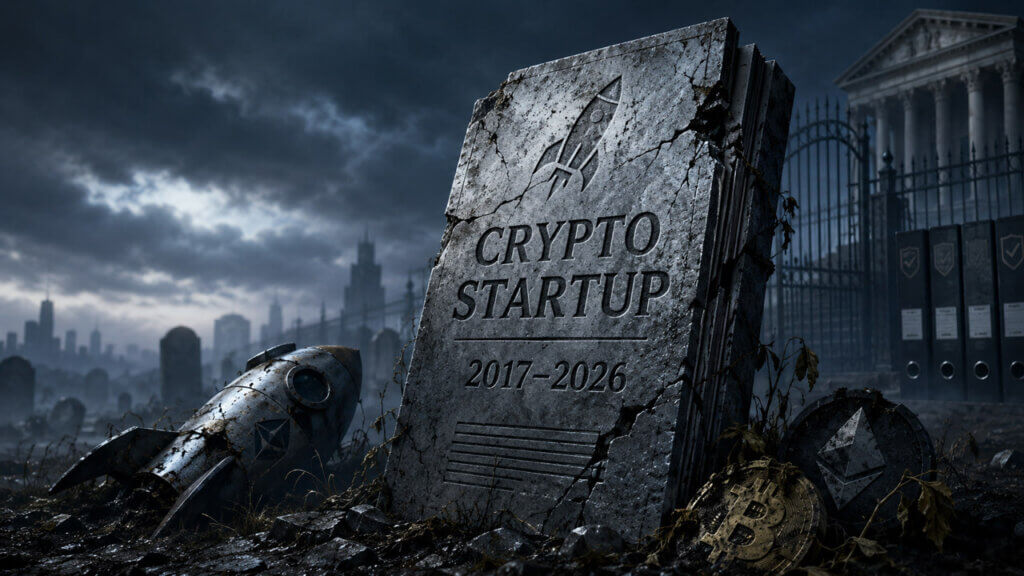
The death of the crypto startup: RIP 2017 – 2026
The industry is shifting from scrappy startups toward institutional consolidation. Jul 5, 2026 · Andjela Radmilac
Closures lag while markets move
Shutdown waves often feel like capitulation and invite the idea that a market bottom is near. However, the sequence is difficult to use in real time, as it happens.
Boards, founders and creditors typically make closure decisions after revenue, financing or legal pressure has persisted. The announcement records where a business’s tolerance ended, while Bitcoin trades continuously against new macroeconomic, liquidity and positioning information.
BitMEX referred to a strategic review of its business and the wider industry. BitMart cited its operating conditions, the market environment and its future direction. Neither linked its timetable to a forecast for digital-asset prices.
Bitcoin’s drawdown supplies historical context with its own limitations. CryptoSlate market data on July 28 shows Bitcoin trading at $63,416, 49.7% below its Oct. 6, 2025 record of $126,198.
That decline is considerably shallower than the final lows of the two previous completed bear markets. CryptoSlate data puts the 2014-2015 decline around 87%, 2017-18 near 84%, and the 2021-22 decline near 77%. Further downside would bring the current path closer to earlier cycles.
A maturing market with deeper liquidity, regulated exchange-traded funds and broader institutional participation could instead complete a cycle with a smaller percentage loss.
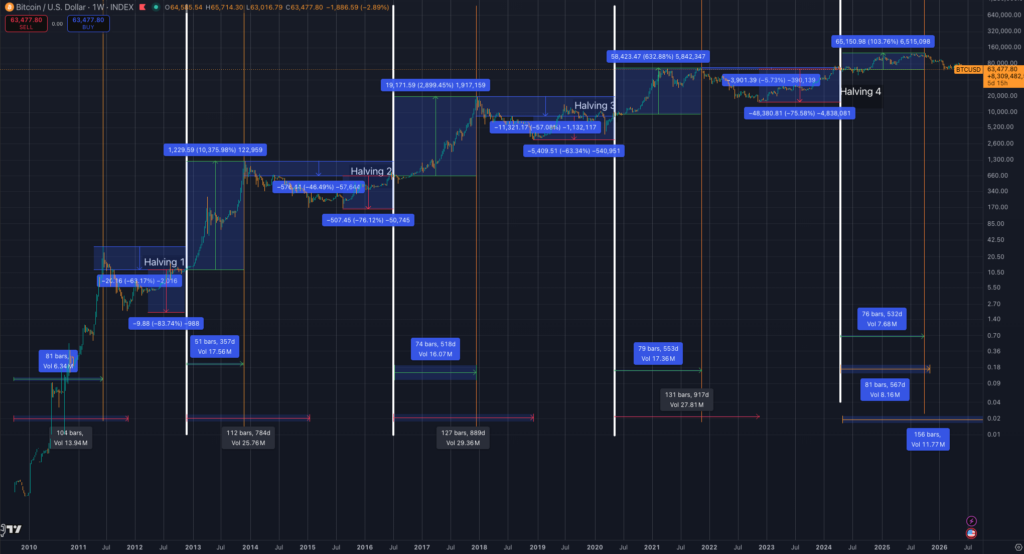
The current drawdown is still open, whereas the older troughs are visible with hindsight. Comparing them establishes scale rather than a price target. MarketVector’s study of Bitcoin drawdowns from 2013 through 2023 found that the first breach of 50% historically offered an unreliable short-term bottom signal. The analysis also relied on a small sample from a market whose structure changed substantially across the period.
A 49% decline therefore leaves both deeper losses and a shallower cycle low within the evidence. Recent CryptoSlate analysis identified cooling losses among long-term holders, improving fund flows and stronger volume as conditions that would make a durable low more credible. Continued distribution, weak demand and more forced business exits would point toward unresolved pressure.
The shutdown wave adds evidence of stress and declining risk appetite. Its varied causes and delayed corporate timelines prevent it from answering the timing question alone.
 Related Reading
Bitcoin crashed and flushed leverage out, but is the bottom here yet?
The liquidation wave cleared crowded long positions, but analysts say Bitcoin still needs ETF stability, fading exchange inflows, and renewed spot demand before the bottom is confirmed. Jun 5, 2026 · Gino Matos
Wall Street is keeping the rails and the institutions
The contraction among crypto-native businesses is unfolding alongside growing institutional use of tokenization. That combination weakens the familiar “crypto is dead” framing.
Blockchain functions are finding buyers, though the emerging architecture often preserves the banks, asset managers and settlement networks that crypto once aimed to displace.
The International Monetary Fund describes tokenized bank deposits as digital representations of existing commercial-bank liabilities that inherit their regulatory and institutional framework. Banks remain central while funding, liquidity management and risk controls change as transactions move onto shared ledgers.
The Bank for International Settlements centers tokenized central-bank reserves, commercial-bank money and government bonds on programmable infrastructure rooted in trusted balance sheets. Swift’s ledger initiative with 17 banks likewise places bank-issued deposits inside existing settlement relationships.
Public blockchains can supply part of that infrastructure. J.P. Morgan has brought tokenized money-market funds onchain, including through Ethereum-based rails. The value chain remains selective: issuers, banks, fund managers, compliance providers and chosen infrastructure capture the activity.
Still, usage on a blockchain establishes demand for its capabilities, while value flowing to unrelated tokens, protocols and applications requires a separate economic link.
Established finance is adopting chosen blockchain functions while many crypto-native companies struggle to prove their own revenue model or token value capture. That split helps explain why this contraction feels different from a simple rejection of the technology.
 Related Reading
Crypto wanted to replace Wall Street – Instead, Wall Street took over crypto
Crypto set out to remove financial intermediaries, but the industry's most successful products now depend on them. Jul 4, 2026 · Andjela Radmilac
CryptoSlate has documented capital concentrating around Bitcoin exchange-traded funds and stablecoin infrastructure and a broader contraction in the startup model. BitMEX and BitMart extend that consolidation into the exchange layer.
The closures may eventually look like late-cycle cleansing, with weak economics recognized shortly before markets recover. They may also mark an earlier stage of consolidation if pressure spreads across more exchanges, protocols and infrastructure providers while Bitcoin demand remains weak.
Crypto is losing businesses, products and part of its promise to build a parallel financial order.
Blockchain is gaining institutional use on terms shaped by regulated finance. BitMEX and BitMart make the bear-market strain harder to dismiss. Bitcoin’s next move will come from trading demand, liquidity and positioning, while closure notices record the damage already done.
The post Is the Web3 startup extinction event here, as Wall Street silently inherits crypto architecture? appeared first on CryptoSlate.