Bitcoin jumped roughly 25% to a two-month high above $77,000 within hours of the U.S. Treasury doubling its long-dated bonds buyback operations on August 19.
Falling Treasury yields triggered a short squeeze estimated $3.5 billion across crypto derivatives.
The move raises a pointed question: did Bitcoin catch a genuine liquidity tailwind, or trade a one-day signal that the bond market itself partially reversed within 24 hours?
BREAKING: Crypto markets officially post their 7th largest liquidation event in history, with $3.5 billion in levered positions liquidated in 24 hours.
In 24 hours, crypto markets added +$280 billion in market cap.
That's +$12 billion in market cap per hour for 24 hours… pic.twitter.com/zpEsLeRhp9— The Kobeissi Letter (@KobeissiLetter) August 20, 2026
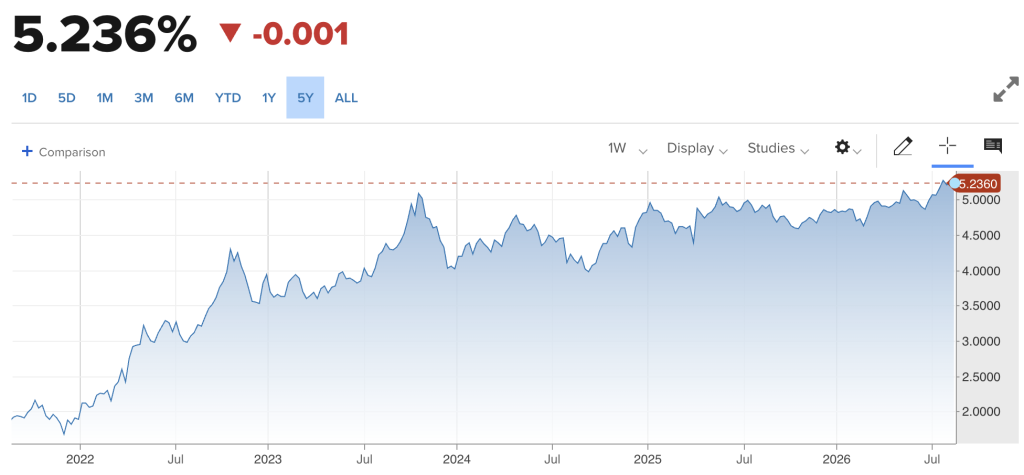
Treasury Secretary Scott Bessent’s move came a day after the 30-year Treasury yield hit 5.34%, its highest level since 2007, amid a global bond selloff tied to inflation worries, an escalating U.S.-Israeli conflict with Iran, and mounting concern over the U.S. fiscal trajectory. Total U.S. debt outstanding crossed $40 trillion the same day the buyback announcement landed.
Discover: The Best Token Presales
What the Buyback Actually Buys
Treasury will double the size of its 10- to 30-year buyback operations to at least $4 billion per operation, up from $2 billion previously, effective September 9 through November 4.
That adds at least $14 billion of additional liquidity support this quarter, bringing maximum repurchases in the current window to $83 billion, measured against a $32.2 trillion Treasury market and $5.5 trillion in outstanding 20- and 30-year bonds.
The announcement worked in the way it was designed to, at least initially: the 30-year yield fell to 5.184% from Tuesday’s high, and the 10-year yield dropped roughly six basis points to 4.66%.
Dan Gottlander, global head of USD and CAD swaps trading at Citi, told Reuters the move would have a huge impact on the long end, though he cautioned that Treasury would still need to issue elsewhere to cover the shortfall.
“It does not change deficits, obviously, and if you are going to buy back the long end, you still will need to issue. They may issue more bills, or also in the five-year to 10-year sector.”
That distinction matters for anyone reading the move as quantitative easing. A Treasury buyback is financed by issuing new short-term bills to retire older, harder-to-trade long bonds, a refinancing operation that swaps one liability for another without expanding the money supply, unlike the Federal Reserve’s own bond purchases under QE, which credit new bank reserves into existence.
Conflating the two overstates how loose the operation actually makes financial conditions.
Discover: The Best Crypto to Diversify Your Portfolio
Why the Relief Didn’t Last
By August 20, Bessent said he might increase buyback sizes even further. “We’re going to increase the size of the buyback,” he said. “I would note that it could be more than the $4 billion per issue.” He argued that yields didn’t reflect the underlying strength of the economy, tying the spike partly to the Iran conflict.

The bond market wasn’t fully convinced. The 30-year yield climbed back to 5.24% by August 20, retracing roughly half of the prior day’s drop, while the dollar clawed back most of its post-announcement losses. According to Bit.com’s market analysis, Bitcoin gave back the $70,000 level within hours, settling into the high-$60,000s after Fed minutes reintroduced rate-hike risk.
Thomas Simons, chief U.S. economist at Jefferies, told Reuters the surprise buyback announcement broke with Treasury’s tradition of predictable debt issuance, calling the move “shot from the hip.”
Evercore ISI analysts framed it more charitably, crediting Bessent’s tactical skill in catching bond shorts off guard during thin August liquidity, but questioned whether the impact would hold given the “tidal wave” of maturing debt and deficits still to be financed.
Trade Crypto Market on Kalshi and Get a $25 Signing-up Bonus
Bitcoin Just Traded a Policy Surprise: Kalshi Lets Traders Position Before the Next One Hits.
The Treasury buyback showed how fast crypto can reprice when a macro decision catches the market off guard. Bitcoin surged, shorts were squeezed, yields fell, and then part of the move unwound as the bond market reassessed what had actually changed.
Kalshi gives traders another way to approach that kind of setup.
The platform offers markets around economic data, Fed policy, politics, crypto, and other real-world events that can move risk assets. Instead of waiting for Bitcoin to react to the next Treasury announcement, rate decision, or inflation print, traders can take a position on the underlying outcome itself.
That distinction matters when the asset reaction is messy. Bitcoin can move on leverage, positioning, dollar strength, and liquidity all at once. An event market lets traders isolate the question they actually have conviction on.
Eligible new users who join Kalshi through CryptoNews can receive $25 through our referral link.
Claim Your $25 on Kalshi
The post Treasury’s $14 Billion Buyback Triggered a $3.5 Billion Crypto Short Squeeze appeared first on Cryptonews.