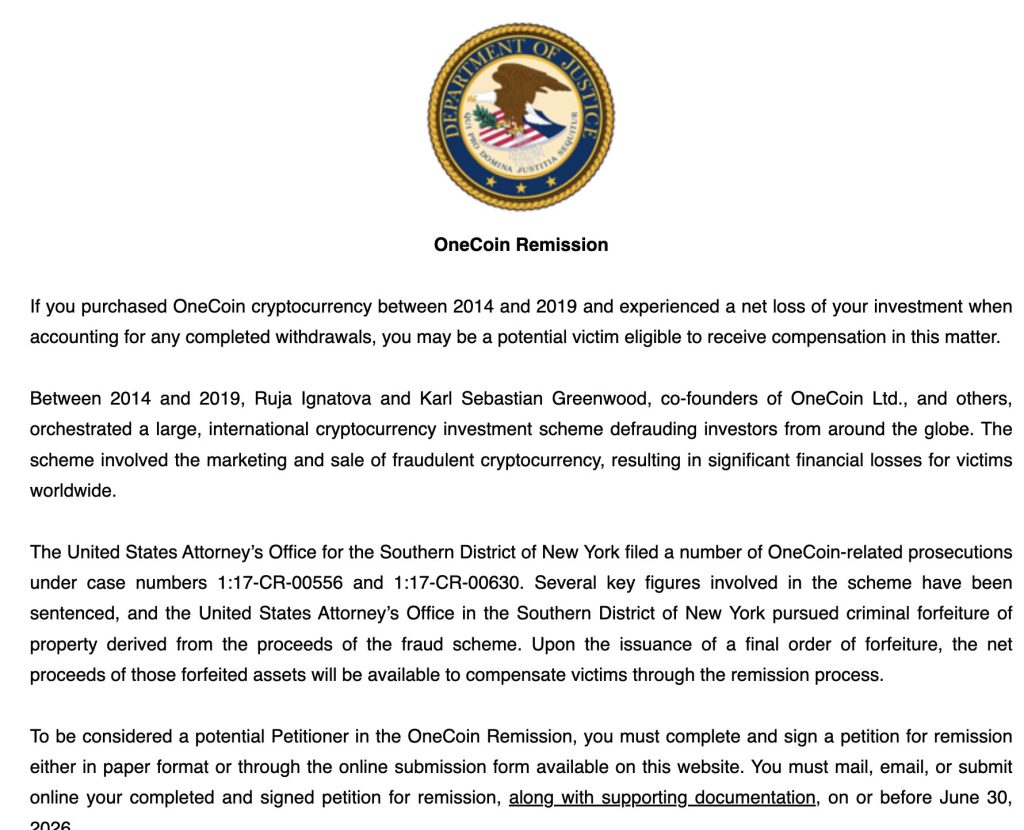
The Department of Justice has opened a formal compensation claims portal for victims of OneCoin, the $4 billion Ponzi scheme that defrauded approximately 3.5 million investors across 175 countries between 2014 and 2019.
More than $40 million in restitution, sourced from asset forfeiture proceedings that swept up proceeds tied to co-conspirators, including Konstantin Ignatov, is now available for verified claimants. The portal is live. The deadline is June 30, 2026.
The question is how many of the scheme’s millions of victims will actually be able to access it, and what fraction of their losses they’ll recover when they do.
Key Takeaways:
- Portal Launch: The DOJ has officially opened a compensation claims process for OneCoin fraud victims, marking the first formal restitution distribution in the case.
- Eligible Victims: Investors defrauded by the OneCoin scheme – including U.S. residents from the Southern District of New York – may file claims to recover verified losses.
- Claims Deadline: Eligible victims must submit claims by June 30, 2026; late submissions are not expected to be considered.
- Asset Source: The $40 million-plus fund derives from criminal asset forfeiture proceedings against proceeds seized from key OneCoin conspirators, including those linked to Konstantin Ignatov.
- Process Overview: Claimants must document their losses and submit through the DOJ portal; restitution amounts will be prorated against total verified claims.
- What to Watch: Ruja Ignatova remains a fugitive on the FBI’s Ten Most Wanted List – billions in unrecovered assets mean the $40 million pool represents roughly 1% of total investor losses.
Discover: The best crypto to diversify your portfolio with
What the DOJ’s OneCoin Claims Portal Actually Does – and What $40 Million Against $4 Billion Means
The DOJ has made available more than $40 million in restitution derived from criminal asset forfeiture, assets seized from conspirators prosecuted in the case, including proceeds linked to Konstantin Ignatov, Ruja Ignatova’s brother, who was arrested at Los Angeles International Airport in 2019 and subsequently pleaded guilty to wire fraud and money laundering charges.
The mechanics work like this: victims file documented claims through the portal, the DOJ verifies losses against available case records, and recovered funds are distributed on a prorated basis relative to total verified claims.
If aggregate verified losses across all claimants exceed $40 million, which is essentially guaranteed given the scheme’s $4 billion total damage, every claimant receives a fraction of their documented loss, not a full recovery.
That’s not a reimbursement. That’s a partial distribution from a forfeiture estate. The DOJ’s asset forfeiture process in crypto fraud cases has grown more sophisticated, but it remains structurally constrained by what investigators can seize versus what was originally stolen, a gap that exploit and fraud cases across the crypto industry consistently expose as the core problem with post-hoc recovery.
Co-founder Karl Sebastian Greenwood was sentenced to 20 years in prison for his role in orchestrating the scheme. The primary architect, Ruja Ignatova, “the Cryptoqueen” – was added to the FBI’s Ten Most Wanted List in June 2022 and remains at large.
The bulk of unrecovered OneCoin proceeds almost certainly moved through jurisdictions outside U.S. enforcement reach. What the DOJ has recovered and forfeited is real. What it represents against total losses is approximately one cent per dollar stolen.
Discover: The best pre-launch token sales
The post DOJ Opens $4 Billion OneCoin Claims Portal for Scammed Investors appeared first on Cryptonews.