Key takeaways:
- Analysts argue that the rising Ethereum inflation rate is not a bad thing really and can actually boost network utility.
- They say the immediate impact of Ethereum’s inflation is likely to be negative on market expectations and investor sentiment.
- Ethereum’s inflationary model contrasts with Bitcoin’s deflationary model, but it offers distinct advantages in network sustainability and adaptability.
Ethereum has turned inflationary and that may not be a bad thing, according to three analysts and founders interviewed by Cryptonews.
Itcomes after the second most valuable cryptocurrency behind Bitcoin saw a steady increase in its average daily supply over the last few months. The annual supply of Ethereum is expected to rise by about $1.5 billion by year-end, thanks in part to a drop in ETH gas fees—the money you pay to complete a transaction on the Ethereum blockchain.
According to data from Ultra Sound Money, the Ethereum supply rose by over 262,008 ETH since the beginning of April to 120,326,493 ETH as of Sept. 6. Gas fees fell nearly 90% during the same period.
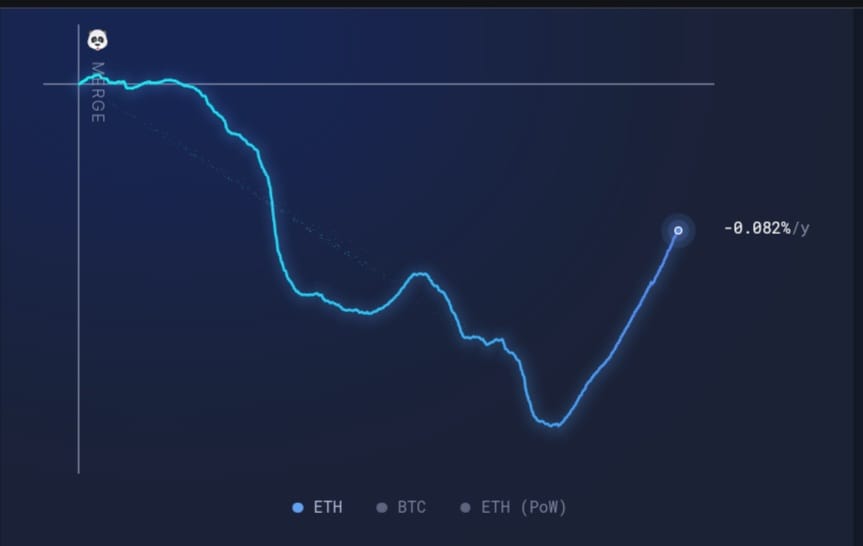
As supply surged, many people began to question the long-term stability and value of Ethereum, pointing to its past deflationary characteristics as an initial drawcard.
However, analysts who spoke to Cryptonews agreed that ETH inflation is not inherently “harmful,” at least in the medium term. That’s because Ethereum’s emission model—or the rate at which new coins enter circulation—is fundamentally different from that of Bitcoin.
“Ethereum has a well-thought-out emission model based on the perception of ETH as a utility token that fuels the Ethereum DeFi ecosystem,” Sasha Ivanov, founder of decentralized open-source platform Waves, said.
“As such, it does not focus on token scarcity the way Bitcoin does with its limited 21 million total supply. Instead, it focuses on long-term network sustainability and ensures that network validators will always be rewarded.”
Inflation Encourages Users to Spend Ethereum
Ethereum has not always been inflationary. In 2022, it moved to a more energy-efficient operating system in a process dubbed “The Merge“, and by the end of March 2024, the number of tokens entering into circulation had declined by over 452,000 ETH, per Ultra Sound Money.
But an update to the ETH network called “Dencun” in March 2024 resulted in lower gas fees and somewhat fed Ethereum’s inflationary cycle.
A certain amount of ETH is destroyed – or “burned”- from the Ethereum network every day to reduce supply. This so-called “burn rate” is currently very low, which has resulted in more Ethereum being issued than “burned.” This low burn rate itself is due to the reduced network fees following the Dencun update.
For example, 7,380 ETH, worth $17.7 million, were “burned” over the last 30 days. That compares with a total of 77,632 ETH, valued at $186.3 million, issued in the same period. Ethereum co-founder Vitalik Buterin praised the Dencun upgrade for saving users up to $100 million in fees.
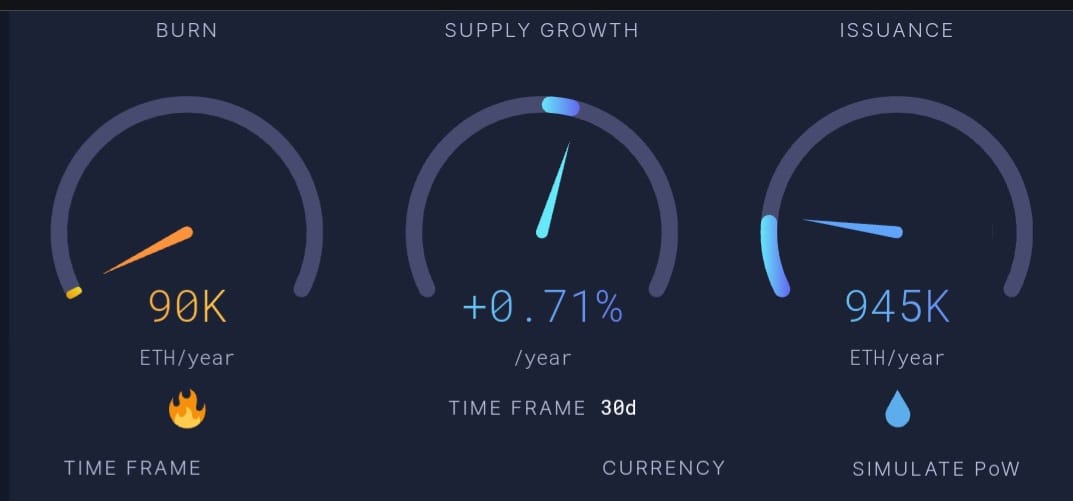
Since the upgrade, however, Ethereum supply has grown at an average rate of 1,652 ETH per day. According to this data and current Ethereum network activity, the annual inflation will be around 600,000 ETH, worth $1.44 billion at the current price, with an inflation rate of 0.7%.
By comparison, Bitcoin’s inflation rate is currently fluctuating at 0.8%, translating to $20 billion annually at current rates, according to Shubh Varma, CEO of New York City-based Hyblock Capital. He said Bitcoin, often lauded for its deflationary model, is still technically inflationary until it reaches its maximum 21 million supply in 115 years.
Solana’s inflation rate stands at 8.9%, which is much higher compared to Bitcoin. This higher rate reflects Solana’s strategy to rapidly expand its ecosystem.
Speaking to Cryptonews, Varma said:
“Contrary to common belief, a low and stable [Ethereum] inflation rate isn’t necessarily harmful; it can actually boost utility. The idea is that a certain amount of inflation encourages users to spend or use ETH rather than just holding onto it (as holding would result in value loss), thus promoting economic activity within the network.”
Varma noted that low transaction fees resulting from the Dencun upgrade may introduce some inflation, “but they also make the network more attractive by supporting greater demand and growth.” He added:
“If network activity and growth outstrip the inflation rate, Ethereum’s value can still appreciate.”
Ryan Lee, chief analyst at Bitget Research, said that ETH’s rising inflation reflects a drop in on-chain activity and a decline in network adoption. He said the immediate impact would be on market expectations and investor sentiment.
“More ETH in circulation makes investors question its long-term value, potentially leading to negative market sentiment,” Lee said.
But he remained optimistic about the long-term implications, suggesting that historically, low gas fees have often signaled a price floor for ETH, leading to strong rebounds in the medium term.
Ethereum is Not Bitcoin
The change in Ethereum’s monetary policy is significant for the network. It challenges the traditional narrative of ETH as a store of value. Instead, Ethereum’s value proposition lies in its utility as a token underpinning an active DeFi ecosystem. This means that the success of Ethereum is closely tied to the growth and adoption of its network rather than its scarcity.
As Bitget’s Lee notes, “Ethereum needs to scale effectively through L2 solutions while maintaining its core value on the mainnet. Solely relying on L2s without adequate incentives for mainnet interaction may not be the optimal strategy.”
Ivanov, the Waves founder, said that in times of high network activity, Ethereum can become deflationary due to its fee-burning mechanism.
“The flip side of this is the higher inflationary pressure during periods when the network is underutilized. If Ethereum’s utility does not grow, it may lead to constant price pressure, which could trigger further underutilization,” he explained.
Ivanov stressed that Ethereum was never meant to be a store of value like Bitcoin, saying:
“Its [ETH] future depends solely on its utility as a token underpinning a rich DeFi ecosystem existing in Ethereum Layer 1 and Layer 2 chains built on top of it. If Ethereum DeFi is successful, its inflation mechanics will only support its success.”
While Bitcoin pioneered the concept of peer-to-peer (P2P) cryptographic transactions, Ethereum brought on the next revolution in crypto with its smart contracts—decentralized apps (dApps) that opened the door to novel financial products, including NFTs, lending, and borrowing.
Within just a year to Nov. 2021, the total sum of value locked in Ethereum-based protocols soared 1,200% to about $109 billion. That figure is down to $44.6 billion, according to data from Defillama. But progress is a double-edged sword.
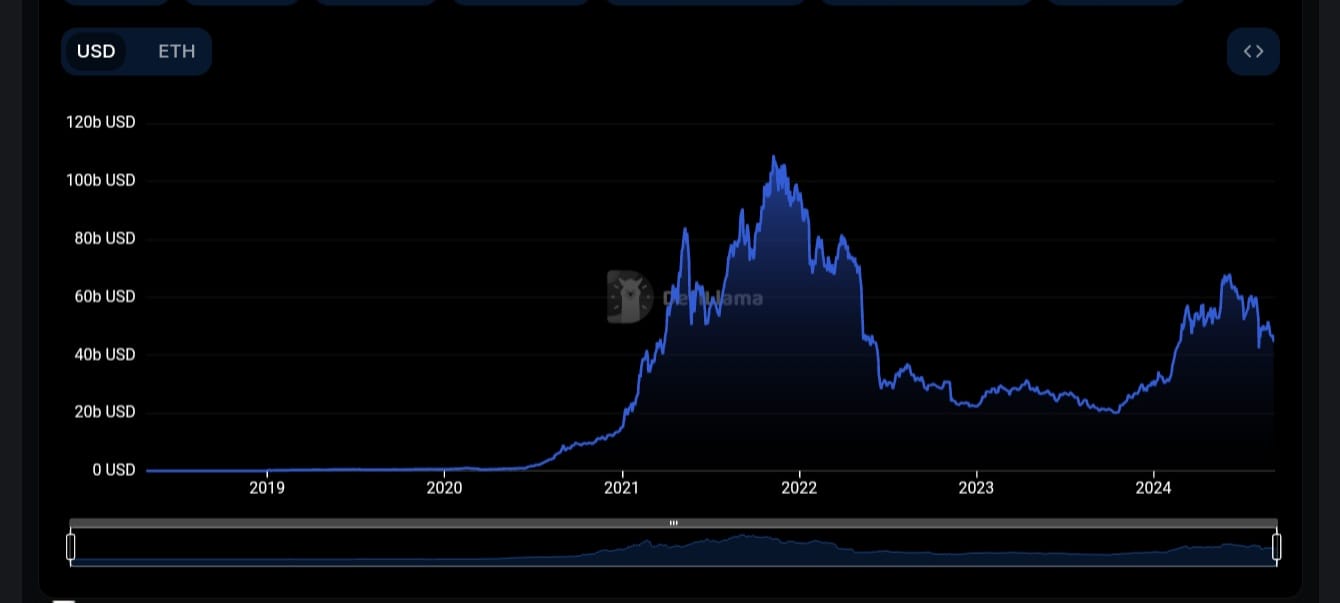
Ethereum found it hard to process the increased number of transactions fast enough, causing fees to rise sharply. Likewise, Ethereum’s energy use hit the roof. If the blockchain was to become the primary vehicle for mass cryptocurrency adoption, it needed a system capable of processing huge transaction volumes per second at a fraction of its energy consumption.
The Merge, which supposedly reduced energy use by 99%, and the Dencun upgrade, which lowered network fees, are all part of Vitalik Buterin’s grand plan of making Ethereum more efficient.
“Bitcoin’s inflexibility raises questions about long-term security as block rewards diminish,” said Lee, the research analyst. He added:
“Ethereum, on the other hand, offers a more adaptable monetary policy that can evolve with the network’s needs, balancing security and usability through its inflationary mechanisms. Yet, this very adaptability introduces uncertainty, which might deter some investors who prioritize a clear, capped supply.”
The post Ethereum’s Rising Inflation ‘Not Necessarily a Bad Thing,’ Analysts Say appeared first on Cryptonews.