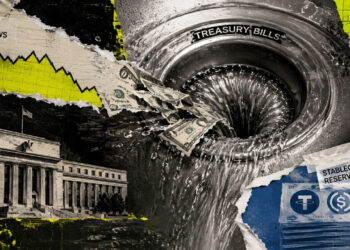
Americans are on pace to lose more money on legal gambling this year than at any point in the country's history.
A new analysis by economics writer Joseph Politano projects that the total will exceed a quarter trillion dollars in 2026. Losses have climbed 67% since the start of COVID-19 and another 8% over the past year alone, outpacing any growth recorded between 2000 and 2020.
That figure counts only sportsbooks and casinos, and it excludes the money moving through prediction markets, crypto trading, and stock options, each of which now channels billions of dollars a year into activity that, economically speaking, looks a great deal like a bet.
The gap between what regulators call gambling and what they call investing has become one of the stranger features of American financial life.
A resident of a state where sports betting is illegal can nonetheless open a crypto prediction market app and take a position on whether the Federal Reserve cuts rates in September, whether a hurricane makes landfall in Florida, or which team wins the World Series.
A trader with no view on economic fundamentals can buy an option that expires in six hours and is, both in theory and in practice, a wager on which direction a stock index moves before lunch.
A teenager with a crypto wallet can invest in a token that exists purely because a meme went viral.
Each of these activities involves risking money on an uncertain outcome, but each falls under a different regulator, a different legal standard, and in some cases, no meaningful oversight at all.
The scale of the gambling problem
The American Gaming Association reported that commercial gaming revenue in the US hit a record $78.72 billion in 2025, up 9.2% from the year before. Sports betting alone generated $16.96 billion in revenue on a total handle of $166.94 billion, an increase of nearly 23% in revenue and 11% in handle over 2024, when Americans had already wagered just under $150 billion legally on sports.
Since the Supreme Court's 2018 ruling in Murphy v. NCAA struck down the federal prohibition on sports betting, 39 states and Washington, D.C. have legalized some form of it, and the industry has expanded every year since.
Politano's analysis highlighted the consequences of such an increase in gambling that extended well beyond sportsbooks' balance sheets. Research cited in his piece found that in states where sports betting is legal, an NFL home team's upset loss raises the rate of intimate partner violence by ten percentage points more than in states without legal betting.
Separate work from New York Fed economists Jacob Goss and Daniel Mangrum, drawing on millions of credit reports, found that debt delinquency rates rose as states legalized sports gambling, with the effect concentrated among men and people under 40. You won't see that in AGA's revenue figures, which measure the industry's growth without capturing the toll it takes on the households funding it.
At the same time, a set of markets that regulators don't classify as gambling at all has grown even faster in percentage terms.
Prediction market activity also surged. Data compiled by Gambling Insider put 2025 notional trading volume across major prediction market platforms at more than $44 billion, with Polymarket and Kalshi together accounting for roughly $38 billion to $39 billion of that total. Polymarket accounted for about $21.5 billion, and Kalshi for $17.1 billion, between January and November 2025.
Options markets and crypto also saw increased retail participation in short-horizon speculation. Total US listed options volume topped 15.2 billion contracts in 2025, a sixth consecutive annual record and a 26% jump over 2024, according to Cboe's year-end report.
Zero-days-to-expiration contracts on the S&P 500, options that are opened and closed within a single day, averaged 2.3 million contracts a day and made up 59% of total SPX volume, with retail traders responsible for roughly half to 60% of that flow.
In crypto, memecoins fell 61% from their early-2025 highs to about $36.5 billion before recovering to roughly $47.3 billion in early 2026. CryptoSlate's own year-end accounting of 2025's worst-performing tokens traced that round trip through a string of celebrity and politically themed launches that left early insiders enriched and late retail buyers underwater.
What makes this collection of activities worth examining together, rather than as separate industries, is that the underlying economic behavior is often identical while the legal treatment is not.
| Activity | Regulator | Legal classification |
|---|---|---|
| Sports betting | State gaming commissions | Gambling |
| Prediction markets | CFTC (Kalshi, Polymarket US) | Financial derivatives |
| Stock options | SEC / CFTC | Investing |
| Crypto derivatives | CFTC | Commodity derivatives |
| Memecoins | Largely unregulated | Digital assets |
A trader who buys a contract on whether the Fed cuts rates in September and a trader who buys an out-of-the-money option tied to the same Fed decision are both using federally regulated market infrastructure to express a short-horizon view.
The sharper contrast is with sportsbook-style event wagers: sports bets routed through licensed books face state gambling rules, while similar event exposure routed through federally regulated prediction markets is being litigated under derivatives law, without the same state licensing, tax collection, or responsible-gambling requirements.
This is the fault line the gambling industry has begun fighting over. AGA estimates that prediction markets offering sports-related contracts have diverted more than $500 million in potential state and tribal betting tax revenue since the start of 2025.
The fight has already produced a tangle of lawsuits and state enforcement actions in Nevada, Massachusetts, Arizona, and Tennessee, all testing whether federal derivatives law preempts state gambling statutes.
The CFTC itself is split on the question along generational lines: former Chairman Gary Gensler filed a brief in June siding with AGA and arguing that Congress never intended his own agency to become a national sports-betting regulator, while the current CFTC has sued states directly to assert exclusive jurisdiction over the same contracts.
The dispute has split the gambling industry itself. DraftKings and FanDuel both resigned from the AGA in November 2025, days before DraftKings launched its own federally regulated event-contract product, after the trade group moved to bar members that operate prediction markets.
Within six months, that product had reached a $3.1 billion annualized trading run rate, a fraction of Kalshi's scale but proof that the state-licensed sportsbook industry now sees more upside in the federal derivatives lane than in the framework it spent a decade building.
Why regulation still depends on category, not risk
The current regulatory framework still depends on legal categories built for different markets: securities law for securities and options on them, commodities law for futures and event contracts, and state gambling law for wagers.
The problem is that newer products and retail trading behavior now blur the practical line between those categories. A same-day option, a sports contract on a prediction market, and a short-lived memecoin trade can expose users to similar loss patterns while triggering very different safeguards.
This produces outcomes that are difficult to justify on any grounds other than historical accident. Depending on platform access and ongoing litigation, a resident of a state without legal sports betting may be able to trade sports-linked event contracts through a federally regulated prediction market with fewer sportsbook-specific restrictions than apply to licensed books in states where betting is legal.
A retail trader can lose a paycheck on a same-day option with the same speed and finality as a losing parlay, but the loss is recorded as an investment outcome rather than a gambling one, exempting it from the responsible-gambling infrastructure states have spent years building.
Meanwhile, a memecoin with no underlying business may avoid meaningful federal oversight unless its launch, promotion, or sale creates securities-law exposure, leaving a large speculative market outside the kind of purpose-built consumer-protection regime applied to gambling.
Economists and gambling researchers who study these overlapping markets tend to argue that regulation should track the risk a product actually poses, factors like leverage, time horizon, addiction potential, and the likelihood of catastrophic loss, rather than which legal bucket a product happens to fall into.
Under that framework, a same-day options contract and a same-day sports bet would face similar scrutiny regardless of which regulator signs off on them, and a memecoin with 99% odds of losing most of its value within two months would not escape oversight simply because it's denominated in stablecoins rather than dollars.
None of this means every dollar routed through prediction markets, options, or crypto tokens represents disguised gambling, and plenty of the activity in each category reflects genuine hedging, price discovery, or long-term investment.
But the country has built an elaborate legal architecture that treats identical economic behavior differently depending on which door a person walks through to place it, taxing and regulating a sports bet made through a sportsbook far more heavily than the same bet made through a federally sanctioned exchange, while leaving an entire category of speculative crypto assets almost untouched.
Americans are losing a historic amount of money across all of these channels simultaneously, and the regulatory system meant to protect them was built for a version of finance that no longer exists.
The post Americans lost hundreds of billions on crypto speculation. Why is only some of it considered gambling? appeared first on CryptoSlate.