The Cardano Foundation announced a partnership with Reef Data eG on July 28, backed by Hamburger Volksbank, ARIC, VALIO, and Disruptive Elements.
Reef plans to pool members' personal data, license it to businesses, and pay royalties back to contributors. Cardano's Reeve system sits at the accounting layer, recording payment flows and royalty distributions, and the underlying data stays elsewhere.
The European Commission Joint Research Centre identifies six models of data intermediary: personal-information management systems, data cooperatives, data trusts, data unions, data marketplaces and data-sharing pools.
The EU Data Governance Act gives that market a regulatory backbone, requiring recognized providers to register with national authorities and appear in a public list.
That list was updated on July 28 and names 36 providers across 10 countries, with Germany's only entry being Law & Innovation Technology GmbH, trading as Consenter. Whether Reef intends to seek a listing of its own is an open question the cooperative has yet to answer publicly.
| Model / initiative | Core idea | Economic logic | Where Reef differs |
|---|---|---|---|
| Personal-information management systems | User controls access to personal data | Privacy/control | Reef adds pooled commercialization |
| Data cooperatives | Member-governed data sharing | Collective bargaining | Reef adds Cardano-recorded royalties |
| Data trusts | Fiduciary-style data stewardship | Governance/trust | Reef is cooperative/commercial |
| Data unions | Users paid for permitted data sharing | Consumer rewards | Reef frames payouts as cooperative royalties |
| Data marketplaces | Buyers purchase datasets | Commercial exchange | Reef supplies consented member data |
| Data-sharing pools | Aggregated data for shared use | Research/public/private use | Reef monetizes the pool |
A cooperative movement already underway
Switzerland's MIDATA Cooperative lets members store health records and grant researchers access under member governance. It operates as a nonprofit and centers participation in research over payment.
Swash rewards users for permitted browsing activity, paying out in cash, gift cards or crypto whenever a business buys the resulting data, insights or advertising.
DataVaults, an EU-funded project spanning 17 partners in nine countries, built personal data hubs years before this week's Cardano announcement. The hubs let contributors control sharing and receive compensation directly.
Spain's SalusCoop asks citizens to conditionally donate health data for research, prioritizing collective and public benefit over individual royalties.
Each project encodes a different theory of what a data company owes its contributors: research access, consumer reward, infrastructure experiment, civic donation. Reef pushes further into commercial territory, selling datasets to buyers and distributing royalties under published, auditable rules.
Reef's published workflow says members request their own information from companies under the EU Data Act. The Data Act, applicable since September 2025, centers on data generated by connected products such as cars, smart devices and industrial machinery.
GDPR Article 15 gives people a right to access data companies hold on them, and Article 20 covers portability in a machine-readable format. The distinction decides whether Reef is executing a right the Data Act just created or repackaging a right GDPR already gave consumers years earlier.
Keeping personal data off the chain
Reef's app keeps personal information off Cardano at the source, reviewing and anonymizing each member's data on their phone, and only the member's own choice sends anything into the cooperative's pool.
From there, Reeve logs the sale, timestamps the royalty payment, and anchors the record cryptographically, so members and auditors can verify the distribution followed the published rules.
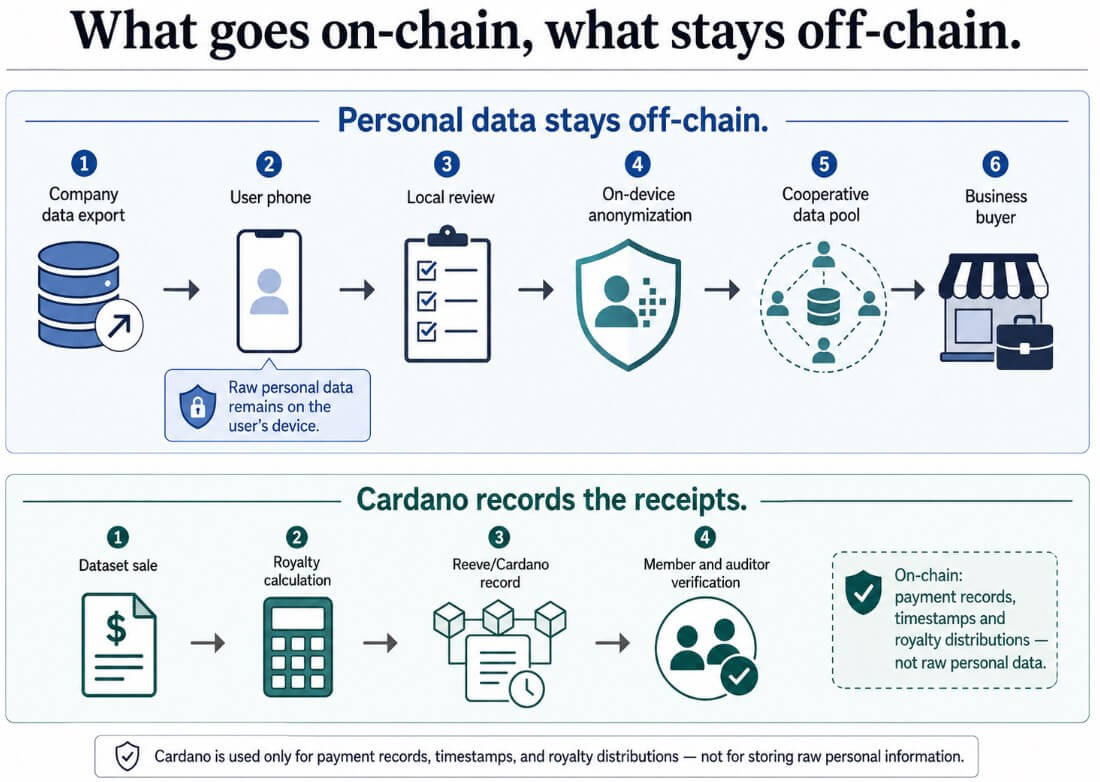
That architecture answers a question the European Data Protection Board raised just weeks earlier, when it adopted final guidance on blockchain technologies on July 7.
The guidance warns that immutable ledgers sit awkwardly against GDPR rights such as erasure and correction, and it recommends that companies keep personal data off-chain wherever possible.
Reeve's own privacy policy describes it as a financial-data integrity and reporting tool for transaction records, a scope Reef's design already respects. Whether by foresight or convenience, Reef built its architecture inside the boundary regulators just drew.
One caveat complicates the on-device anonymization claim, as EU data-protection authorities separate true anonymization, which removes data from GDPR's scope entirely, from pseudonymization.
Pseudonymized data still counts as personal information whenever a technique or dataset combination can link it back to a person.
Reef has published limited technical detail about its on-device process. Whether it clears the anonymization bar, or produces data that stays personal under EU pseudonymization rules, is still unclear.
What the payout math shows
Global data monetization estimates vary by source: Reef's own case study cites $3.95 billion in 2025, climbing to $19.32 billion by 2032.
Independent forecasts from Grand View Research, Research and Markets, and Stratistics MRC put the same market between $3.9 billion and $5.29 billion today. Each projects growth toward figures between $16.3 billion and $29.46 billion within seven to eight years.
Reef is entering a narrower lane: organized data marketplace platforms, worth $1.5 billion in 2024. Grand View Research projects the category will reach $5.7 billion by 2030 at a 25.2% compound annual growth rate.
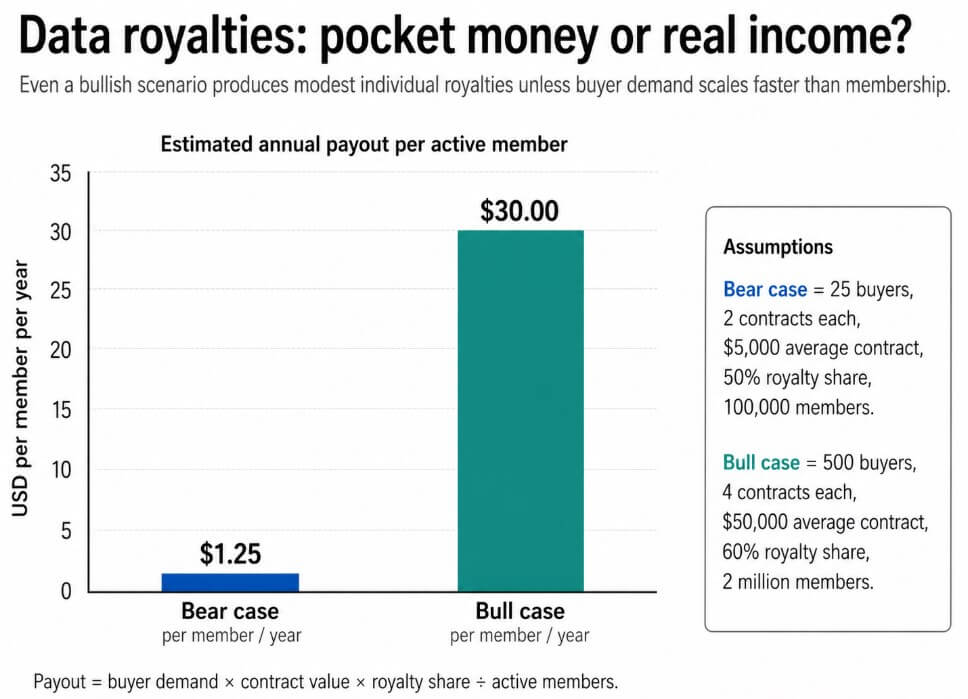
Whether that growth reaches individual members depends on a simple ratio: buyer demand divided by membership size.
In the bear case, 25 buyers sign two contracts each at $5,000, with a 50% royalty share split across 100,000 active members. That produces roughly $1.25 per member a year, closer to a provenance experiment than a paycheck.
In the bull case, 500 buyers sign four contracts each at $50,000, with a 60% royalty share split across 2 million active members. That produces about $30 per member a year: a real number, and a small one, worth about two coffees a month.
The bull case rests on buyers paying a premium for consented, auditable data. A study spanning tens of millions of ad impressions found prices dropped 18% to 23% whenever advertisers lost access to user-level tracking.
That gap points to measurable value in identifiable, permissioned data. Consented data commanding that kind of premium consistently, across many buyers and categories, is a separate and unproven claim.
The test
An audit trail on Cardano proves that a sale happened and that Reef split the proceeds the way its rules describe.
Lawful sourcing, genuine on-device anonymization and a fair buyer price are areas Reef's own governance rules handle. MIDATA, Swash, DataVaults and SalusCoop have worked through that same terrain for years, relying on committee votes, consent forms and cooperative bylaws.
Reef's contribution is a public, tamper-evident record of who got paid and how much, for data people used to hand over for nothing.
In theory, collective bargaining can turn personal data into real income, and an auditable ledger can make a notoriously opaque data market trustworthy enough for people to opt in at scale.
How large Reef's buyer list grows will decide both claims, leaving the choice of ledger as background bookkeeping underneath them.
The post New Cardano partnership promises to monetize your private data, but payouts likely start at just $1.25 a year appeared first on CryptoSlate.