The convertible notes, preferred shares, and credit facilities that financed a large share of corporate Bitcoin holdings carry maturities, redemption windows, and dividend dates that determine when a company might need to sell.
Matthew Sigel, VanEck's head of digital assets research, shared a list of corporate Bitcoin treasuries that maps who ranks above the coins inside each company's capital structure.
Once Bitcoin sits inside a public company's balance sheet, it stands beneath a stack of claims: creditors expecting repayment, preferred shareholders expecting distributions, lenders holding pledged coins, common shareholders wanting buybacks, and an operating business that needs cash to run.
A payment, redemption, or maturity can force a company to sell Bitcoin on a fixed date, regardless of whether it still believes in the asset's long-term price.
One entry on Sigel's list flags Bitdeer, which had fully emptied its Bitcoin treasury as of Feb. 20 to fund a pivot into AI data centers, a move later confirmed when the treasury fell to zero once the company sold 189.8 newly mined BTC and pulled 943.1 BTC from reserves.
| Claim above Bitcoin | Instrument or pressure | What creates the sell risk | Why it matters |
|---|---|---|---|
| Creditors | Convertible notes, senior debt | Maturity, repayment, refinancing failure | BTC may be sold even if management remains bullish |
| Preferred shareholders | STRC-style preferred stock | Dividend dates, yield ratchets, par support | Recurring cash obligations turn BTC into liquidity |
| Secured lenders | Credit facilities backed by pledged BTC | Collateral ratios, margin pressure, loan repayment | Coins may already be encumbered before a sale |
| Common shareholders | Buybacks, mNAV pressure | Stock trades below NAV or below par | Selling BTC can become more rational than issuing equity |
| Operating business | Capex, payroll, strategic pivots | Cash needs outside the treasury strategy | BTC can become working capital, as with Bitdeer |
Reading Strategy's balance sheet
Strategy's own 10-K states its Bitcoin holdings function as a core component of its balance sheet and capital structure, providing the economic backing for its equity and fixed-income securities. The same filing ties that strategy to continued access to equity and debt financing.
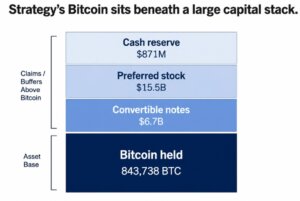
As of May 25, Strategy reported 843,738 BTC alongside $6.7 billion in convertible notes, $15.5 billion in preferred stock, and an $871 million cash reserve.
That access came under real strain through STRC, Strategy's variable-rate perpetual preferred stock. The stock held near par through mid-May 2026, then traded below it for 30 straight sessions as Bitcoin fell from an October high near $126,000 toward $58,000 in late June.
In late May, Strategy sold 32 BTC for about $2.5 million to fund STRC distributions, its first Bitcoin sale since it began accumulating the asset in 2022. STRC kept falling, closing at $89 on June 18 and $83 two days later.
Strategy paused the at-the-market program it uses to issue new shares and buy Bitcoin, since issuing stock below par would dilute existing holders.
On June 29, Strategy answered with what it called a Digital Credit Capital Framework. The plan raised STRC's dividend to 12% and added a ratchet that lifts the rate another 0.5 percentage points each time the stock closes below $95, adding roughly $53 million in annual obligations per trigger.
The same announcement authorized a BTC Monetization Program permitting sales to fund the cash reserve, preferred dividends and interest, and buybacks of its own securities. It disclosed a reserve of about $2.55 billion at that point, enough to cover roughly 17.4 months of preferred dividends and interest, which it put at about $1.76 billion a year.
Michael Saylor addressed the decline directly, saying that “volatility tests every capital structure” on June 26.
STRC still traded near $85 as of July 23, about 15% below par, with an effective yield above 13%. JPMorgan flagged the new sales policy as a source of two-way risk for Bitcoin markets, and Onramp Institutional estimated retail investors hold about $8.8 billion of STRC, roughly 83% of the buyer base.
The same mechanics beyond Strategy
MARA sold 15,133 BTC in March to repurchase about $1 billion of convertible notes due 2030 and 2031.
Its first-quarter filing said it sold roughly 20,880 BTC during the quarter, held 35,303 BTC at quarter's end, and had loaned or pledged 9,995 BTC, including 4,253 BTC against a $150 million credit line.
KULR's 2026 filing shows the same mechanic at a smaller scale: a May drawdown carried a first-priority security interest in Bitcoin collateral, and the company pledged 300 BTC against the $15 million loan, above the minimum required.
The treasury trade worked best when three conditions lined up: Bitcoin rose, shares traded above net asset value, and capital markets stayed open to new equity, converts, and preferred issuance.
Issuing new shares to buy Bitcoin adds Bitcoin per share and keeps the machine accumulating as long as the stock trades above that line.
Once it falls below, new equity dilutes existing holders, and preferred and convertible issuance gets harder to place. The same machine can run in reverse: selling Bitcoin to fund buybacks, dividends or debt becomes the more rational move.
Treasury companies pitched Bitcoin as reserve capital strong enough to anchor a balance sheet, financing the purchases with convertible debt and preferred stock that tied that same balance sheet to conditions outside any single company's control: Bitcoin's price, the mNAV premium, open capital markets, refinancing windows and serviceable preferred distributions.
When those conditions weaken, a company may sell its most liquid asset to defend the financial structure it built around that Bitcoin.
The calendar ahead
The sector has accumulated billions in debt and preferred financing, with maturities concentrated in 2027 and 2028.
In the bull case, equity and preferred markets reopen, mNAV premiums return, and Bitcoin's climb makes new issuance accretive again.
Companies roll debt and preferred obligations without touching their core holdings, and calendar-driven selling stays close to 0.5% to 1.0% of the 1.285 million BTC public companies hold today, or roughly 6,400 to 12,900 coins over the next two years.
In the bear case, refinancing gets difficult, mNAV discounts persist, and convertibles stay out of the money as Bitcoin weakens.
Collateral haircuts widen, preferred distributions strain cash reserves, and calendar-driven selling climbs to 6% to 10% of public-company holdings, or roughly 77,100 to 128,500 BTC, arriving on a fixed schedule of maturities and payment dates.
| Scenario | Market conditions | Corporate response | Estimated BTC supply over two years | Meaning for the market |
|---|---|---|---|---|
| Bull case | BTC rises, mNAV premiums return, capital markets reopen | Companies refinance, roll obligations and issue accretively | 6,400–12,900 BTC | Selling remains tactical and limited |
| Base case | BTC trades sideways, funding remains available but costly | Companies selectively sell BTC for reserves, dividends or buybacks | 25,700–51,400 BTC | BTC becomes a treasury-management tool, not just a reserve asset |
| Bear case | BTC weakens, mNAV discounts persist, convertibles stay out of the money | Companies sell to meet maturities, preferred distributions and collateral pressure | 77,100–128,500 BTC | Selling becomes calendar-driven supply |
| Stress case | One large treasury company loses refinancing access | BTC sales, restructuring or collateral enforcement accelerates | 192,800+ BTC | Corporate-held BTC is repriced as contingent supply |
The figure worth tracking for each company is how much of its Bitcoin sits free of debt, preferred claims and pledge agreements, and how much already has a creditor, a dividend or a maturity date in line before it.
That breakdown will decide how much of the industry's Bitcoin behaves like reserve capital, and how much behaves like collateral waiting on a due date.
The post The debt clock ticking inside corporate Bitcoin treasuries could force billions back onto the market appeared first on CryptoSlate.