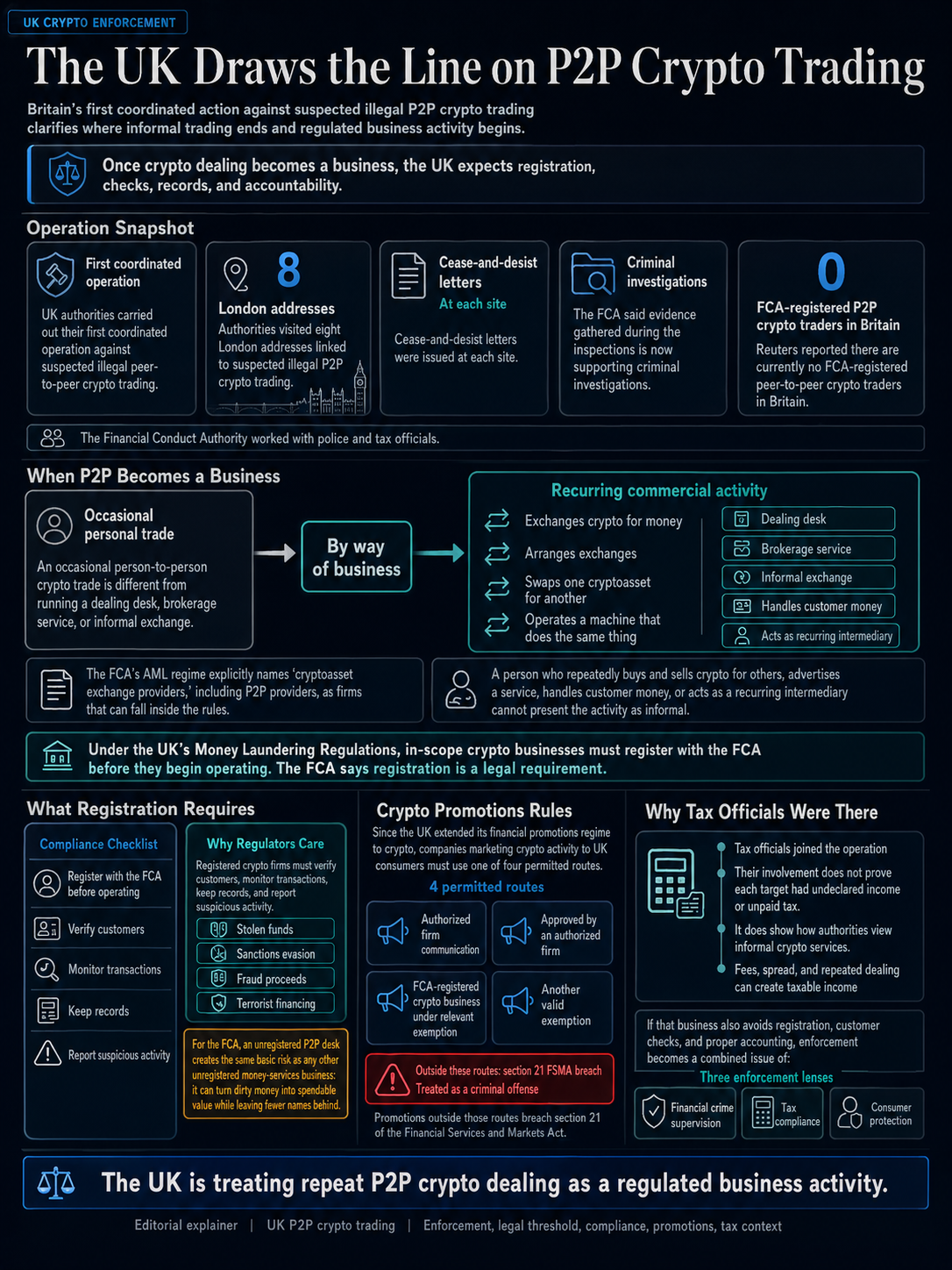
UK authorities have carried out their first coordinated operation against suspected illegal peer-to-peer crypto trading, sending a clear and simple message to the market: once a person turns crypto dealing into a business, the state expects names, checks, records, and accountability.
The Financial Conduct Authority (FCA) said it worked with police and tax officials to visit eight London addresses linked to suspected illegal p2p crypto trading, issuing cease-and-desist letters at each site. Evidence gathered during the inspections is now supporting criminal investigations, according to the regulator, while Reuters reported that there are currently no FCA-registered peer-to-peer crypto traders in Britain.
The legal side is fairly easy to understand. In the UK, an occasional person-to-person crypto trade isn’t the same as running a dealing desk, brokerage service, or informal exchange. The line is crossed when someone regularly exchanges crypto for money, arranges those exchanges, swaps one cryptoasset for another, or operates a machine that does the same thing “by way of business.”
The FCA’s anti-money-laundering regime explicitly names “cryptoasset exchange providers,” including p2p providers, as firms that can fall inside the rules. A person who repeatedly buys and sells crypto for others, advertises a service, handles customer money, or acts as a recurring intermediary can’t describe the activity as informal.
Under the UK’s Money Laundering Regulations, in-scope crypto businesses must register with the FCA before they begin operating, and the regulator says registration is a legal requirement.
 Related Reading
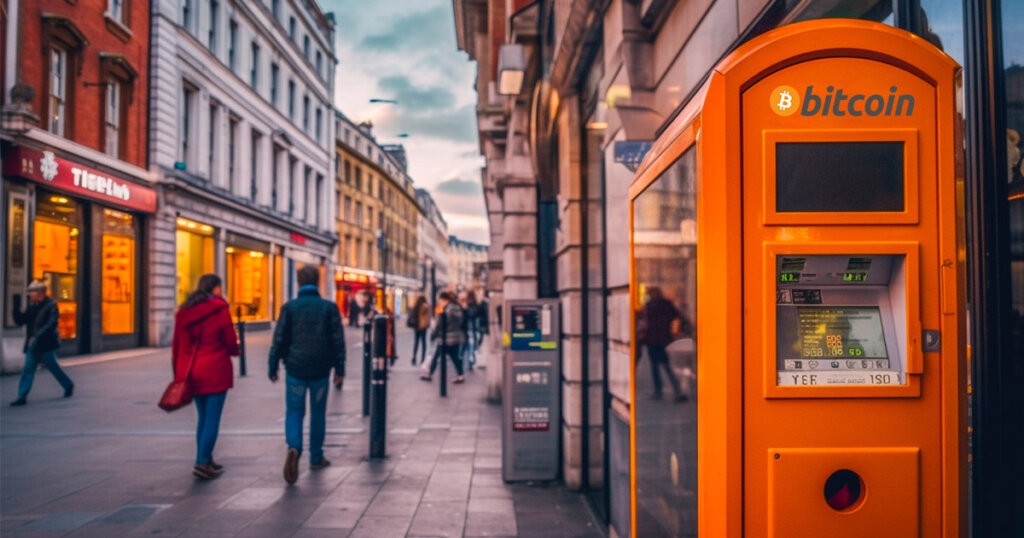
UK’s FCA takes action against illegal crypto ATM operators
The UK FCA said no crypto ATM operator was registered with it, making their operations illegal in the country. May 5, 2023 · Oluwapelumi Adejumo
The reason is anti-money laundering. A registered crypto firm has to verify customers, monitor transactions, keep records, and report suspicious activity. These requirements are part of the financial system that makes it harder for stolen funds, sanctions evasion, fraud proceeds, and terrorist financing to move through apparently ordinary payments.
For the FCA, an unregistered peer-to-peer desk creates the same basic risk as any other unregistered money-services business: it can turn dirty money into spendable value while leaving fewer names behind.
There is also the issue of promotions. Since the UK extended its financial promotions regime to crypto, companies marketing crypto activity to UK consumers must use one of four permitted routes.
These include communication by an authorized firm, approval by an authorized firm, communication by an FCA-registered crypto business under the relevant exemption, or another valid exemption. Promotions outside those routes breach section 21 of the Financial Services and Markets Act and are treated as a criminal offense.
Having tax officials involved in the investigation just makes it more complicated. It doesn’t prove that each target had undeclared income or unpaid tax, but it shows how authorities see informal crypto services.
A business that takes fees, earns spread, or generates gains through repeated dealing can create taxable income. If that business also avoids registration, customer checks, and clean accounting, enforcement turns into financial crime supervision, tax compliance, and consumer protection wrapped into one operation.
The UK has already moved crypto inside the perimeter
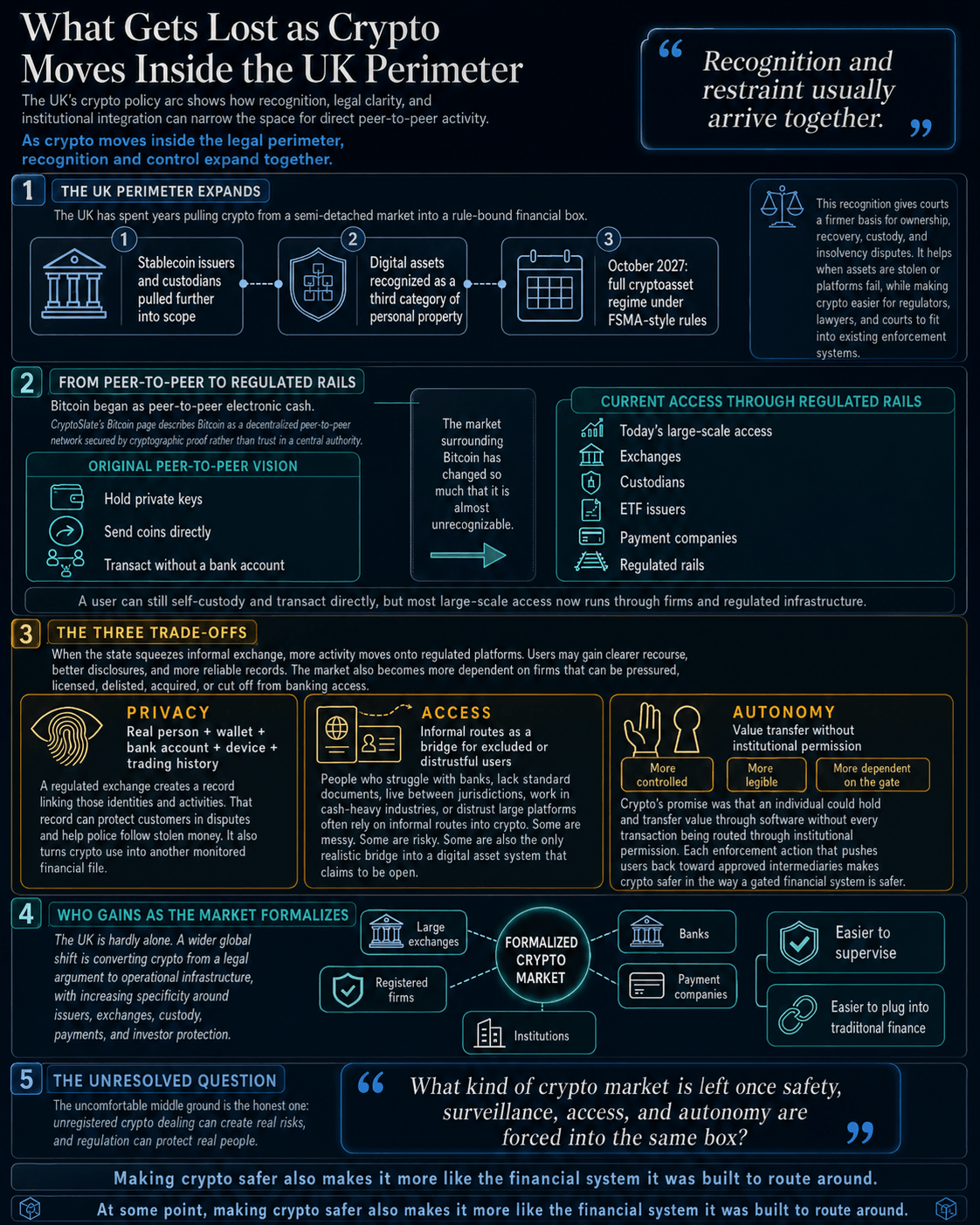
The UK has spent years pulling crypto from a semi-detached market into a rule-bound financial box. CryptoSlate has covered that process in several stages, from the FCA’s expanded reach over stablecoin issuers and custodians to the UK Treasury’s October 2027 deadline for a full cryptoasset regime under FSMA-style rules.
 Related Reading
Stablecoin issuers and custodians in UK may be regulated like banks next
FCA warns investors protections are coming but volatility won’t disappear. Sep 17, 2025 · Oluwapelumi Adejumo
The country has also clarified that digital assets can be treated as a third category of personal property, giving courts a firmer basis for ownership, recovery, custody, and insolvency disputes. That legal recognition helps crypto owners when assets are stolen, or platforms fail, and makes crypto easier for regulators, lawyers, and courts to fit into existing enforcement systems.
Recognition and restraint usually arrive together. The more the state accepts crypto as property, market infrastructure, payment technology, or collateral, the more it wants to know who's providing the service, who's responsible when something breaks, and who's checking whether criminal money is moving through the system.
Bitcoin began as a peer-to-peer electronic cash system, and CryptoSlate’s Bitcoin page still describes it as a decentralized peer-to-peer network secured by cryptographic proof rather than trust in a central authority.
Yet the market surrounding Bitcoin has changed so much that it's almost unrecognizable. A user can still hold private keys, send coins directly, and transact without a bank account, but most large-scale access now runs through exchanges, custodians, ETF issuers, payment firms, and regulated rails.
That creates a legal distinction that regulators can work with. Holding Bitcoin is one thing, but running a recurring business helping strangers buy and sell it is another. Running an informal service that substitutes for an exchange while avoiding the controls that exchanges must follow is exactly the kind of activity the FCA is designed to stop.
Seen that way, the raid is legally clean. The FCA isn’t inventing a new rule on the fly or regulating through enforcement. Its guidance states that companies and sole practitioners providing in-scope crypto services in a business capacity must register, and its registration page specifically includes peer-to-peer providers in the category of cryptoasset exchange providers.
The question we have to ask now is what gets lost when the law is enforced this way.
The raid narrows the space where crypto still feels like crypto
Peer-to-peer crypto has always carried two meanings at once. To regulators, it always looks like a gap in surveillance: direct trades, fewer records, weaker identity checks, and easier movement between cash, bank transfers, stablecoins, and wallets.
But to crypto-native users, it's one of the last visible pieces of the original design: two people exchanging value without asking a bank, broker, app store, payment processor, or exchange for permission.
A person using p2p markets to run an unlicensed exchange isn’t defending financial freedom. They're using the language of decentralization to avoid obligations every other money-handling business has to follow, especially in the UK.
Still, enforcement of this kind changes the shape of the market for people who never planned to commit a crime. When the state squeezes informal exchange, more activity moves onto regulated platforms.
That gives users clearer recourse, better disclosures, and cleaner records. It also means more identity checks, more transaction monitoring, more account freezes, and more dependence on firms that can be pressured, licensed, delisted, acquired, or cut off from banking access.
The first loss is privacy. A regulated exchange creates a record that links a real person to a wallet, a bank account, a device, and a trading history. That record can protect customers in disputes and help police follow stolen money, but it can also turn their crypto use into another monitored financial file.
The second loss is access. People who struggle with banks, lack standard documents, live between jurisdictions, work in cash-heavy industries, or simply distrust large platforms often rely on informal routes into crypto. Some of those routes are messy, some are risky, and some are also the only realistic bridge into a digital asset system that keeps claiming to be open.
The third loss is autonomy. Crypto’s promise was never only price appreciation, although that is what pulled most people in. It was the idea that an individual could hold and transfer value through software, without every transaction being routed through institutional permission.
Each enforcement action that pushes users back toward approved intermediaries makes crypto safer in the way a gated financial system is safer: more controlled, more legible, and more dependent on the gate.
The UK is hardly alone here. CryptoSlate’s end-of-the-year review of 2025 regulation described a world in which major jurisdictions began converting crypto from a legal argument to operational infrastructure, with rules on issuers, exchanges, custody, payments, and investor protection becoming more specific. T
he FCA’s London operation fits that global direction. Informal access points are being pulled toward the same perimeter as centralized platforms.
That may help large exchanges and registered firms. It may also make life easier for banks, payment companies, and institutions that want crypto exposure without informal counterparties sitting beside them. The market becomes easier to supervise and easier to plug into traditional finance.
It also becomes less peer-to-peer in the most basic meaning of the phrase.
The uncomfortable middle ground is the honest one. Unregistered crypto dealing can create real risks, and regulation can protect real people.
At the same time, a system that treats every repeat act of informal exchange as a business to be registered, monitored, and supervised leaves less room for the kind of direct financial activity that made crypto culturally powerful in the first place.
The UK may be right on the law. It may even be right on enforcement. The open issue is what kind of crypto market is left once safety, surveillance, access, and autonomy are all forced into the same box.
At some point, making crypto safer also makes it more like the financial system it was built to route around.
The post UK police raids on people trading crypto for cash raises a hard question about financial freedom appeared first on CryptoSlate.