Over the past year, the artificial intelligence trade has become one of the main pillars supporting global risk appetite.
However, the Bank for International Settlements (BIS) is now warning that the same spending boom could become a source of financial stress if expected returns fail to arrive.
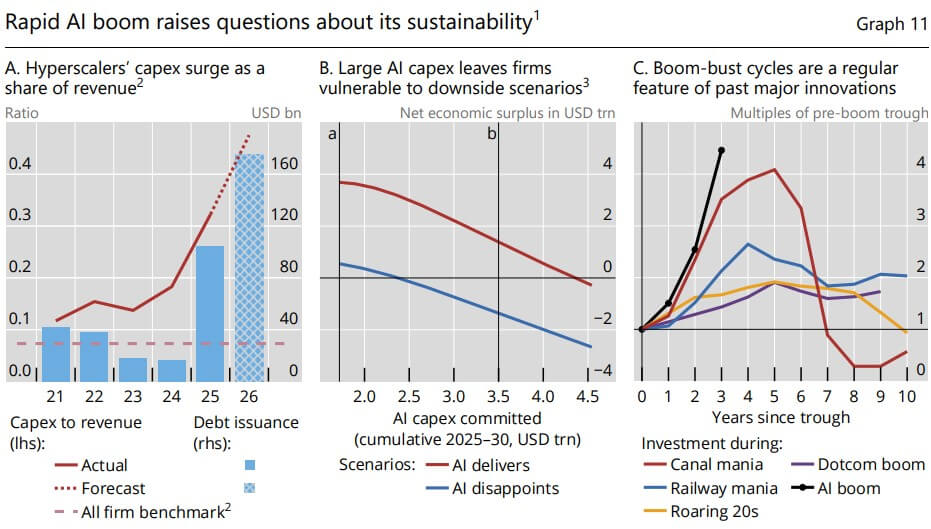
The Basel-based organization, which advises central banks, said in its annual economic report that the five largest hyperscalers are on track to spend more than $1 trillion on AI-related capital expenditure across 2025 and 2026.
The BIS said the scale of investment has raised questions about whether companies are committing too much capital before the business case has been fully proved.
According to the BIS:
“Disappointment in returns could trigger a sudden pullback in financing and turn the capex boom into a protracted investment bust, with potential knock-on effects on financial conditions.”
For Bitcoin traders, the warning reaches beyond Silicon Valley’s race for chips and data centers.
A sharp reversal in AI spending could tighten liquidity across equities and credit, forcing crypto into a difficult test: whether Bitcoin trades first as another risk asset in a selloff, or whether its longer-term monetary argument begins to regain force after the shock.
AI spending boom draws central-bank scrutiny
The BIS, which serves as a forum for central banks, used its annual economic report to warn that the race to dominate artificial intelligence may be pushing investment beyond levels that future returns can support.
BIS stated:
“The current surge in capital expenditure could prove unsustainable if supply bottlenecks restrain production. Intense competition for market leadership may fuel overinvestment further, as seen in previous innovation waves, increasing the risk of a sharp reversal if AI payoffs disappoint.”
The concern is not that AI lacks economic potential. The BIS said the technology could eventually lift productivity in ways that separate it from earlier waves of automation and software development. If AI systems become capable of improving their own performance and helping generate new ideas, the long-term macroeconomic impact could be significant.
However, the near-term financial risk is different. Companies like Google, OpenAI, and Anthropic are committing enormous sums before there is clarity on how much revenue the spending will produce, how durable that revenue will be, and how quickly the infrastructure behind AI will become obsolete.
Indeed, the largest technology companies have poured money into chips, cloud capacity, data centers, electricity supply and networking equipment as they compete for users and market share.
The scale of that race has helped reinforce investor confidence in technology stocks, while also lifting demand across suppliers and infrastructure firms tied to the AI buildout.
However, the BIS warned that fierce competition can create its own vulnerability. If every major player spends heavily to avoid falling behind, the sector can end up with too much capacity, lower returns, and a financing structure that becomes difficult to sustain once optimism fades.
That dynamic has appeared before. The BIS pointed to earlier investment booms tied to canals, railways, electrification and the internet.
While each technology later changed the economy, they also produced periods when investors financed too much too quickly, which eventually resulted in painful reversals.
In view of this, the BIC concluded:
“The scale and pace of the current AI investment boom accompanied by expectations of large productivity payoffs bear resemblance to these precedents, highlighting potential downside risks in the near term.”
Compounding the problem are severe physical bottlenecks. The voracious appetite for computational power is straining the supply of advanced semiconductors, grid equipment, and raw electricity.
According to the BIS, this surging demand is already pressuring electricity prices upward, threatening to bleed into broader inflation metrics at a time when geopolitical conflicts in the Middle East have independently strained global supply chains.
Credit risks build beneath the equity rally
Meanwhile, the BIS concern extends far beyond a simple stock market correction and into how the AI shock could impact the broader financial system.
While the early stages of AI development were largely financed through the massive cash reserves of Silicon Valley leaders, the current trillion-dollar scale of investment requires a heavier reliance on debt and increasingly opaque financing structures.
BIS pointed out that AI infrastructure now reaches across corporate debt markets, private credit, lease financing, data-center construction, energy contracts and supplier agreements.
Chipmakers, cloud providers, AI labs, and data-center operators are increasingly linked through equity stakes, purchase commitments and long-term capacity deals.
In fact, Onramp Bitcoin, a BTC-focused financial service firm, recently pointed out that:
“A web of overlapping commitments now binds the AI buildout into a roughly $1 trillion loop: Nvidia invests in AI labs like OpenAI, the labs rent cloud capacity from Oracle and CoreWeave, and the clouds buy Nvidia chips. The same dollar can be booked as investment, funding, revenue, and sales at once, so the headline demand figures stop meaning quite what they seem to.”
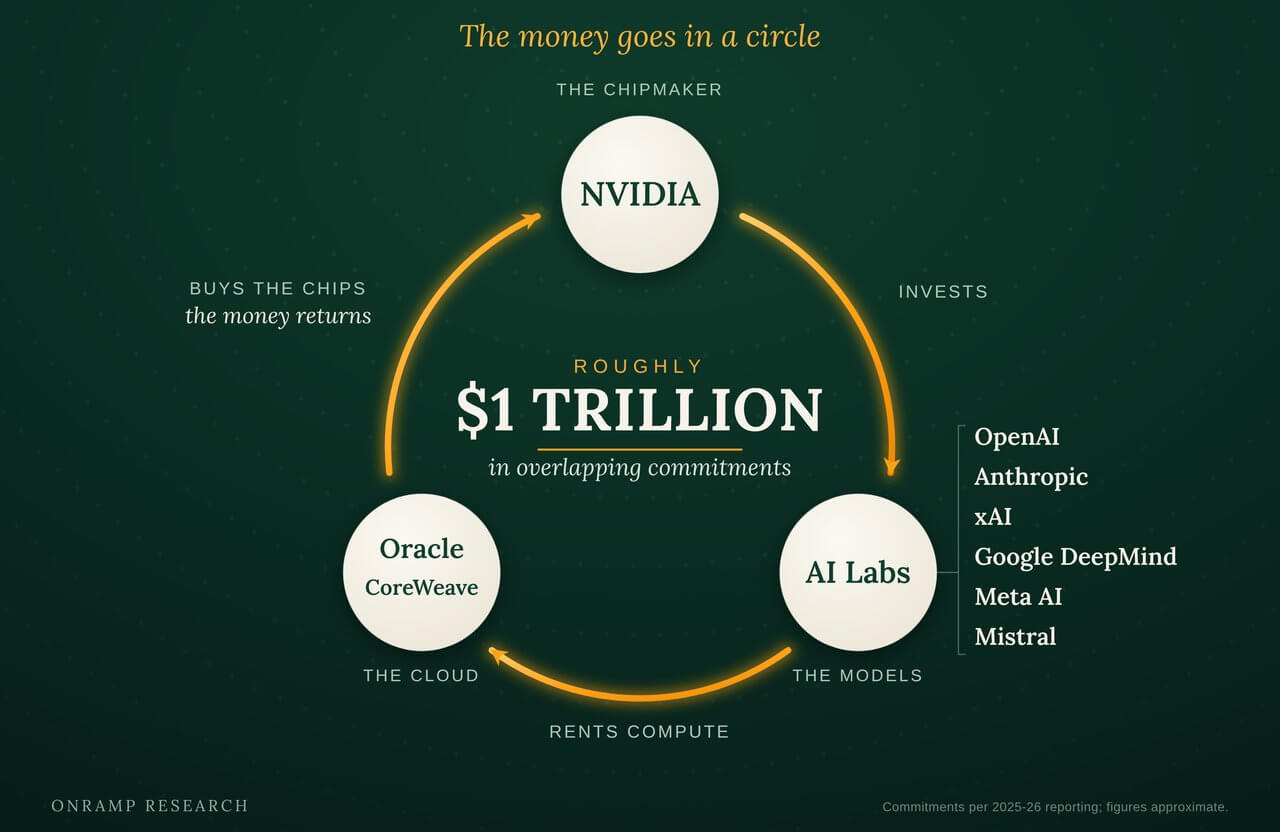
The BIS warned that those arrangements can make risks harder to see, noting that the web of claims is built on expected future demand. If AI adoption keeps accelerating, the structure can reinforce itself.
However, stress can move back through the chain if demand disappoints.
This would result in a situation where suppliers may lose orders, and data-center developers may struggle to fill capacity.
At the same time, private credit funds may face pressure on loans tied to software, infrastructure or technology borrowers. And banks may find that their exposure to private credit and nonbank finance is more complicated than headline numbers suggest.
That is why the BIS warning extends beyond technology shares. A fall in AI-related equities would hurt investors directly. A broader reassessment of AI financing could tighten credit conditions for companies that depend on the same funding environment.
Credit spreads have remained relatively narrow, reflecting investor confidence that borrowers can keep servicing debt.
A sharp repricing of equity risk could change that quickly. Once lenders demand more compensation for risk, weaker borrowers face higher refinancing costs, reduced access to capital and pressure to cut investment.
That is the path through which an AI disappointment could become a macro event.
Bitcoin’s first reaction may be defensive
Bitcoin’s role in that kind of economic shock would be complicated as the asset is often presented by supporters as a hedge against monetary debasement, fiscal stress and the fragility of the financial system. Its supply is fixed, it has no corporate issuer, and it does not depend on a company’s earnings or debt repayment schedule.
Those features may become more attractive if an AI credit bust eventually forces policymakers to ease financial conditions. But in the early stage of a broad selloff, Bitcoin would likely face the same pressure as other risk assets.
When liquidity tightens, investors often sell liquid positions first. Bitcoin trades continuously, can be sold quickly, and is held by many investors who also own equities, exchange-traded products, derivatives, and other high-beta assets. That makes it vulnerable when portfolios are being de-risked.
Recent market behavior supports that concern. CryptoSlate recently reported that Bitcoin fell under $63,000 after South Korea’s benchmark KOSPI stock index plunged nearly 10% last week.
That decline showed that liquidity conditions, leverage, and risk appetite can dominate scarcity narratives for long periods.
An AI-led market shock could follow a similar sequence. Technology stocks tied to the buildout would likely fall first. Credit spreads could widen as investors reassess debt linked to data centers, suppliers and private financing vehicles. Funds facing losses or margin pressure may then cut positions across crypto and other liquid assets.
In that phase, Bitcoin would not need a direct connection to AI infrastructure to be affected. It would only need to be part of the same risk budget.
The liquidity question comes next
However, the second stage depends on the government's response to the ensuing market carnage.
If a reversal in AI investment remains contained within a small group of technology companies, the damage may stay limited. Equities would reprice, suppliers would adjust, and investors would reassess valuations without forcing a major shift in monetary policy.
But the risk flagged by the BIS is that the spending boom has grown large enough to affect the wider financial system.
This suggests that a significant pullback in AI capex could hit corporate investment, employment, household wealth and credit availability at the same time. Those pressures could become more severe if inflation remains elevated and central banks feel unable to cut rates quickly.
That creates a difficult setup for risk assets. Higher inflation could keep policy tight even as investment weakens. Tighter credit could expose leverage in private markets. Falling equity prices could reduce household wealth and slow consumption. Each channel could reinforce the others.
For Bitcoin, the policy path is crucial. The asset has often performed best when liquidity expands, real rates fall, and investors expect central banks to support markets. A credit shock that eventually brings easier money could revive that trade.
Arthur Hayes, the co-founder of BitMEX, has argued that an AI bust could help drive Bitcoin much higher if authorities respond with renewed liquidity creation and investors rotate away from debt-heavy financial structures.
That view remains speculative, but it captures why some crypto traders are looking at AI capex and credit markets as potential drivers of the next Bitcoin cycle.
However, the timing is uncertain. So, a trader betting on the eventual liquidity response may still have to endure the drawdown that comes before it.
The post Why a collapse in $1 trillion AI spending boom could hit Bitcoin traders first appeared first on CryptoSlate.