A new global financial crisis is not confirmed, but the path toward one is now visible enough to map.
The sequence starts with debt and oil before it reaches credit. Long-end sovereign yields and Brent crude are already close enough to stress levels to make the policy squeeze urgent.
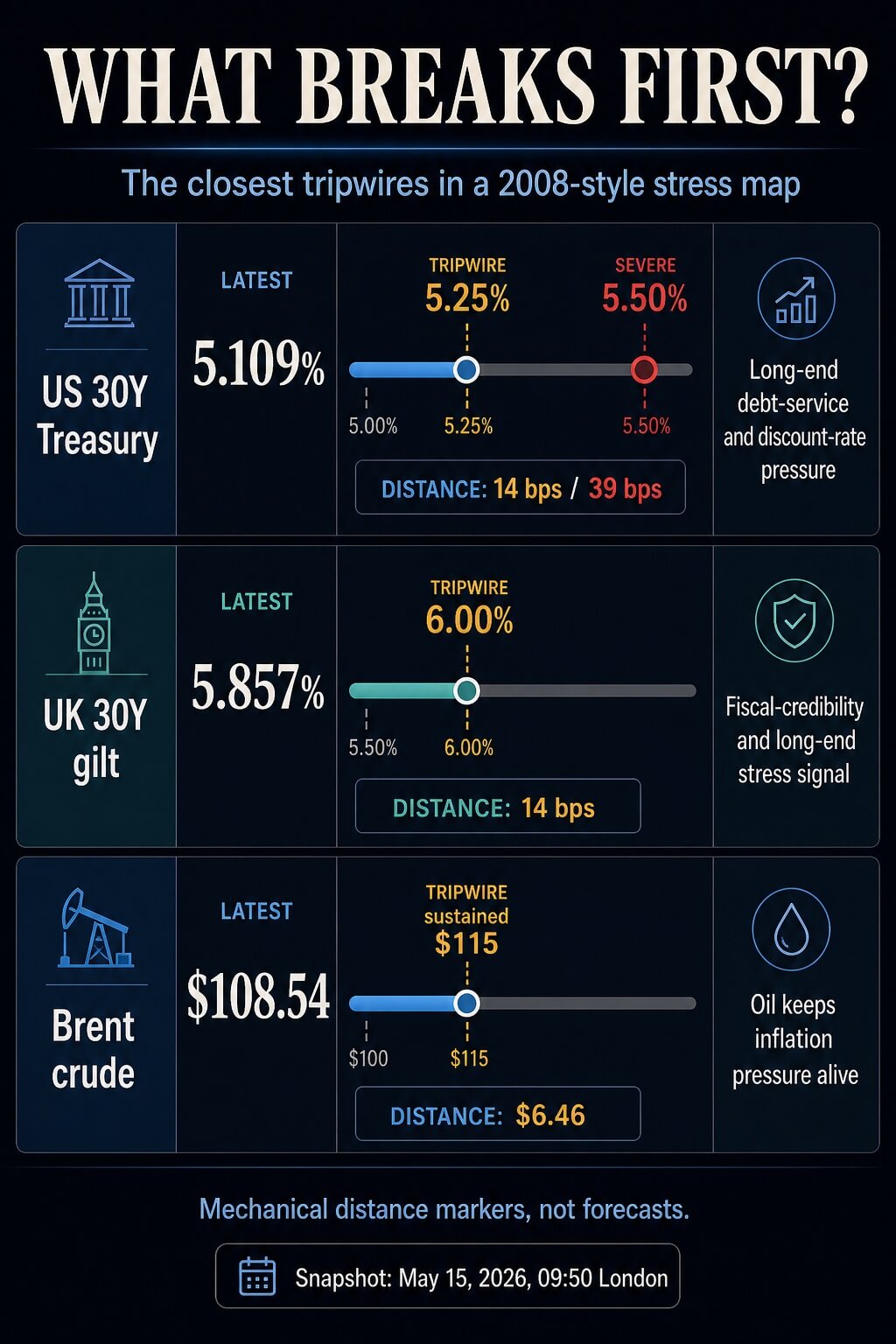
To close out the week, the US 30-year Treasury yield was near 5.109%, the UK 30-year gilt was near 5.857%, Brent was near $108.54, and the VIX was near 18.53.
Those numbers point to a market moving toward the part of the map where a bond shock and an oil shock can start forcing other markets to respond.
The distinction is practical. A 30-year Treasury yield above 5.25%, a UK 30-year gilt above 6%, or sustained Brent above $115 would all worsen the debt-service and inflation problem.
But a 2008-style event needs more than expensive government debt and energy. It needs stress to migrate into credit, volatility, financial conditions, funding markets, and forced selling.
The broad data still shows a different picture. US high-yield option-adjusted spreads were still only 2.82% on May 13, below the long-term average of 5.19%.
A later FRED update put the same credit-spread family at 2.76% for May 14. The Chicago Fed National Financial Conditions Index was still -0.524 for the week ending May 8, and negative NFCI readings indicate looser-than-average financial conditions.
That leaves markets in a split state: the warning signals are close, but the confirmation signals have not arrived.
 Related Reading
Global financial crisis fears grow as bond yields hit 1998 levels and Bitcoin drops below $80,000
Sovereign bond yields are nearing historic stress levels as inflation and energy shocks revive fears of a global financial crisis. May 13, 2026 · Liam 'Akiba' Wright
The dashboard markets should watch
| Indicator | Latest reading | Tripwire | Distance | What it means if broken |
|---|---|---|---|---|
| US 30Y Treasury | 5.109% | 5.25% warning, 5.50% severe stress | About 14 bps to 5.25%, 39 bps to 5.50% | Long-end debt-service pressure starts looking like a fiscal and discount-rate problem, not just a bond-market move. |
| UK 30Y gilt | 5.857% | 6.00% | About 14 bps | UK long-end stress moves into a fiscal-credibility zone that can spill into sterling, pensions, and risk assets. |
| Brent crude | $108.54 | Sustained $115 | About $6.46 | Oil keeps inflation pressure alive and limits the ability of central banks to rescue markets quickly. |
| VIX | 18.53 | 25 warning, 30 serious risk-off | About 6.5 points to 25, 11.5 points to 30 | Equity markets stop treating the shock as background noise and start paying for protection. |
| US high-yield OAS | 2.82% on May 13 | 4.5%-5.0% | About 168 bps to 4.5%, 218 bps to 5.0% | The story shifts from rate stress into credit-event confirmation. |
| Chicago Fed NFCI | -0.524 for week ending May 8 | 0.0 | 0.524 index points | Broad financial conditions cross into tighter-than-average territory. |
The closest breaks are the US 30-year, the UK 30-year, and Brent. The more important confirmation points are high-yield spreads, VIX, and NFCI.
A mechanical one-day gauge shows why the first group matters. If the US 30-year repeated its 9.6 basis-point daily move, it would reach 5.25% in roughly 1.5 trading days and 5.50% in roughly 4.
If the UK 30-year repeated its 20.6 basis-point move, 6% would be less than one trading day away. If Brent repeated its $2.82 daily gain, $115 would be two to three trading days away.
Treat those as distance markers, not forecasts. They show how close the market is to levels where the narrative changes.
Why bonds and oil break first
Long-end yields are the first pressure point because they transmit stress into almost everything else.
For governments, higher 30-year yields raise the cost of refinancing at the same time budgets are already under pressure. The IMF's April 2026 Fiscal Monitor said global public debt rose to just under 94% of GDP in 2025 and is projected to reach 100% by 2029, with public finances strained by rising interest burdens.
That makes every long-end yield spike more than a chart event. It raises the price of time for governments, households, banks, insurers, pensions, and companies that rely on long-duration valuations.
The transmission can arrive without a single dramatic failure. Higher long-end rates can lower the value of bond portfolios, pressure mortgage and corporate refinancing costs, and make equity valuations harder to defend.
They also force governments to choose between tighter budgets, heavier issuance, and higher interest bills. A move from stress to crisis can start quietly in duration markets before it shows up in layoffs, bank funding, or default risk.
Oil adds the second pressure channel. The EIA described the Strait of Hormuz as a critical chokepoint, with 2024 oil flows averaging about 20 million barrels per day, or roughly 20% of global petroleum liquids consumption.
The World Bank said Brent could average as high as $115 in 2026 under a severe-disruption scenario involving damage to critical oil and gas facilities and slow export recovery.
 Related Reading
Bitcoin only has one path through 2026 because massive oil price contagion just spread to 8 major economies
Hormuz-driven oil stress is forcing policy shifts across 8 economies, leaving Bitcoin stuck between liquidity squeeze and support. May 12, 2026 · Liam 'Akiba' Wright
Brent is central to the GFC question because it can keep inflation elevated, weaken real incomes, pressure margins, and reduce the room central banks have to cut rates if markets start to fall.
It does not need to directly break the banking system to make a subsequent credit event harder to fight.
In 2008 and 2020, policymakers could eventually move hard toward financial rescue. In this setup, the constraint is different.
Rescue too early, and inflation credibility comes under pressure. Wait too long, and financial stability can break first.

What would confirm the shift into systemic stress
The hard break requires more than the US 30-year alone. A 5.25% or 5.50% 30-year Treasury would be a major warning, but it would still be a warning.
The same holds for a 6% UK 30-year gilt or Brent above $115.
The confirmation would come from migration.
First, volatility would need to stop looking orderly. A VIX move through 25 would show equity investors paying up for protection.
A move through 30 would be a more serious risk-off signal, especially if it came while long yields and oil were still rising.
Second, credit would need to reprice. The high-yield spread, around 4.5% to 5.0%, is the more important line because it would indicate that investors are no longer treating the shock as a rate problem.
They would demand more compensation for default and liquidity risk.
That is the point at which the story shifts from macro pressure to credit stress. The distance from 2.82% to 4.5% is about 168 basis points.
That gap is why the current evidence falls short of a 2008-style credit event.
Third, financial conditions would need to tighten broadly. An NFCI crossing above zero would indicate that the stress is no longer confined to rates, oil, or equities.
It would mean money markets, debt markets, equity markets, and the banking system are collectively tighter than average.
Only after that would the real systemic channel come into view: funding pressure, collateral calls, liquidity holes, bank balance-sheet stress, and forced deleveraging.
That is the part that turns a harsh macro correction into a financial crisis.
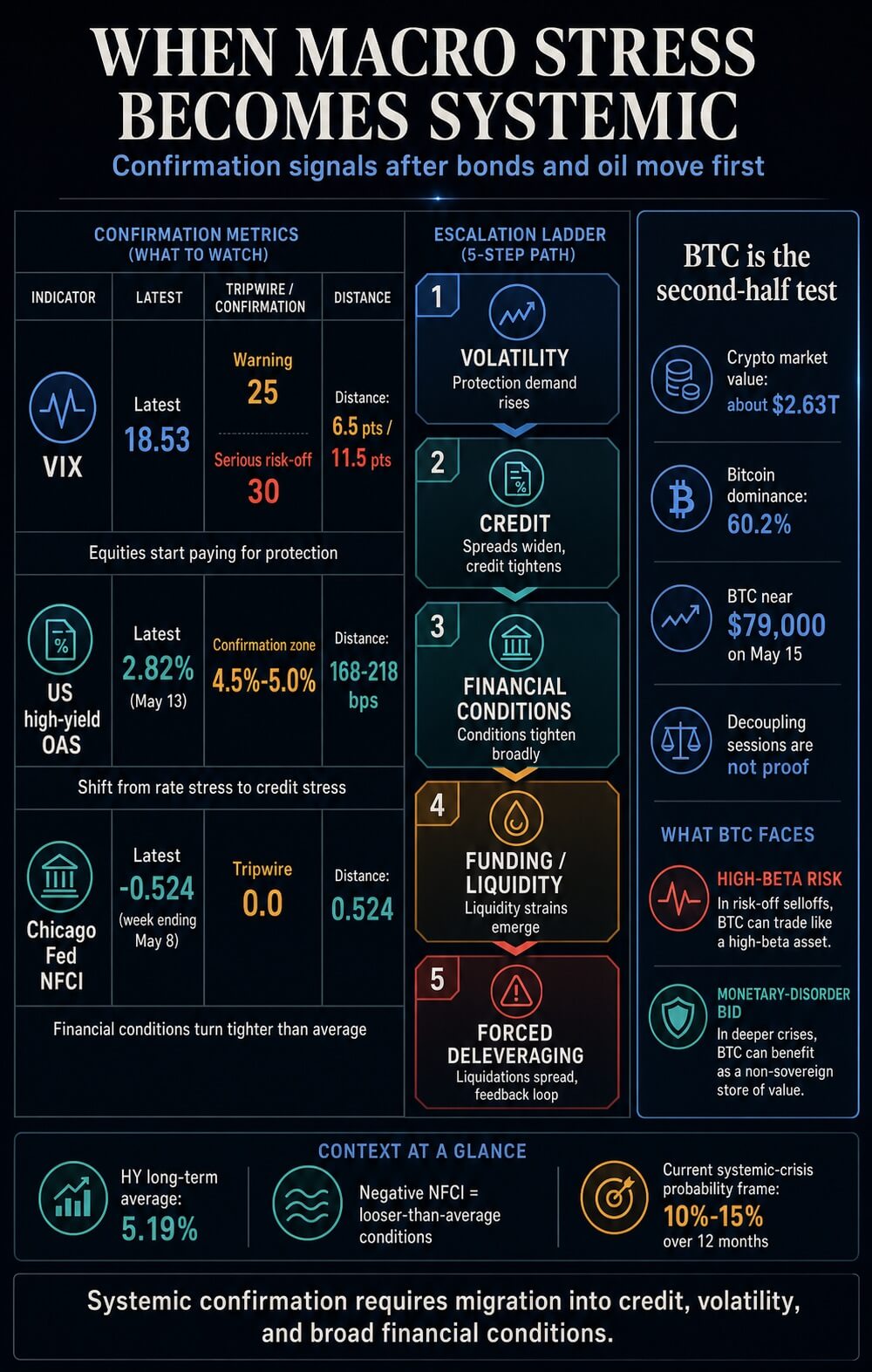
On current evidence, that remains a second-order scenario. A reasonable 12-month range remains around 10% to 15%, rising toward 15% to 20% if the US 30-year breaks 5.25%, the UK 30-year breaks 6%, Brent stays above $115, and the VIX moves above 25.
A high-yield spread move through 4.5% would matter more than any single bond print because it would show credit catching the shock.
Where Bitcoin fits into the test
Bitcoin comes after the macro test.
The crypto market is large enough to react to the same liquidity forces driving stocks, bonds, and commodities. CryptoSlate's market pages show a total crypto market value of $2.6 trillion, with Bitcoin dominance around 60%.
The Bitcoin page shows BTC near $78,000 going into the weekend, down about 2.8% over 24 hours.
Recent CryptoSlate coverage has already shown why the Bitcoin signal is complicated. BTC has at times broken from US equities while oil, yields, and the dollar pressured stocks, with Bitcoin now below $80,000 even as the S&P 500 hits new records.
 Related Reading
Bitcoin decouples from S&P 500 as oil, yields, and dollar pressure stocks
BTC’s break from stocks now depends on whether buyers can absorb oil, yield, and dollar pressure at the same time. May 5, 2026 · Liam 'Akiba' Wright
Still, one or two decoupling sessions fall short of proving a durable regime change. If this remains a bond-and-oil shock without credit confirmation, Bitcoin may trade the usual mix of liquidity expectations, real-rate pressure, dollar moves, ETF flows, and risk appetite.
It can diverge for a session or two without proving that it has become a crisis hedge.
If the shock moves further into credit, the test becomes harder. In a true deleveraging phase, investors sell what they can, not only what they want to sell.
Bitcoin could trade like high-beta collateral first, especially if volatility rises and liquidity becomes scarce.
The bullish macro case would need to survive that phase. BTC would have to show investor demand, treating it as protection against fiscal stress, monetary disorder, or policy credibility risk after the forced-selling pressure subsides.
That is a higher bar than outperforming stocks on a mixed macro day.
The path also depends on what drives the selloff. A rates-led repricing tends to pressure long-duration assets and speculative exposure.
An oil-led inflation shock can hit risk appetite while also raising questions about the purchasing power of fiat. A credit-led break is harsher because it turns liquidity into a scarce asset.
Bitcoin's response across those three states would tell markets more than any single daily correlation print.
The line between correction and crisis
Markets are still short of saying 2008 is here. Yet they say the path to that kind of event is visible enough to monitor in real time.
The first part of the path is already close: long-end US and UK yields, oil, inflation pressure, and constrained central banks.
The second part is still missing: high-yield spreads above 4.5% to 5.0%, VIX above 25 to 30, and NFCI above zero.
That distinction means that if a new GFC-style event is developing, the bond and oil numbers should break first.
The confirmation comes only when credit, volatility, and financial conditions follow.
Until then, the label is a dangerous macro-correction risk rather than a confirmed systemic crisis.
The post Markets are moving toward a new global financial crisis. These are the tripwires that would confirm it appeared first on CryptoSlate.