Most people aren’t focused on price charts – they care about being paid on time, sending money without high fees, and completing transactions without unnecessary steps. That’s why more banks, processors, and payment networks are testing blockchain-based payment rails.
They’re already moving real money in real workflows, from merchant settlements to cross-border payouts, and it’s happening faster than many expected.
Card networks test stablecoin settlement, regulators write playbooks, and merchants just want fewer steps between a sale and cleared funds.
If this technology wants to succeed beyond the crypto crowd, it must nail what traditional finance already knows: money movement should be predictable, low-cost, and seamless.
Payments Win When the Rules Are Clear
Policymakers are leaning towards where the utility is obvious. They are distinguishing speculative activity from fiat-backed tokens designed to simplify checkout and cross-border payments. In the European Union, for example, the MiCA framework sets a single rulebook for e‑money, as well as asset‑referenced tokens, with phased implementation dates and new ESMA guidance.
Another example is Singapore, which has finalized a stablecoin regime that requires high‑quality reserves and 1:1 redemption. Furthermore, Hong Kong has moved ahead with a licensing system for fiat‑referenced stablecoin issuers. The direction is simple: if a use case solves speed, fees, or access, authorities will create a lane for it.
Legacy Payment Companies Are Powering the Change
Regulators opened that lane, and the big networks already drove into it. Payments now look like the most scalable option for mainstream use. For example, PayPal’s Pay with Crypto promotes up to 90% lower cross‑border costs folded right into a checkout flow people are already familiar with. No seed phrases, no tutorials, just pay and get paid.
Another giant, Visa, reports settling $225M+ in stablecoin volume and continues to expand supported tokens, blockchains, and even a euro-denominated option. Meanwhile, Mastercard partnered with Paxos’ Global Dollar Network to integrate regulated stablecoins into existing money‑movement products.
In addition, PayPal’s PYUSD stablecoin is being introduced on the Stellar network to expand everyday payments and remittance options.
Imagine sending low-cost payments internationally that settle instantly.
With @PayPal's PYUSD on Stellar, that experience is just around the corner for shoppers and merchants. pic.twitter.com/GrMq7dYA6u— Stellar (@StellarOrg) June 27, 2025
Trading-First Platforms Are Blocking Real Adoption
The problem is that many crypto platforms still look like trading apps, dominated by charts, order types, and tickers.
Sure, this approach worked during speculative cycles. But it does not help a contractor who wants to invoice in dollars, a marketplace that needs same‑day settlement, or a corner shop that simply wants funds to land in a bank account without surprises.
Complexity at the surface pushes mainstream users away. To put it simply, if a payout requires choosing a chain and guessing a network fee, most opt out.
Utility prevails when outcomes are straightforward: tap to send, and funds arrive. Customer support can handle the edge cases, and compliance fits into the flow without scaring users. A trading‑first mindset makes all of that harder and narrows the audience that the industry can serve.
The Core Principles of a Financial Utility
Reshaping this approach suggests treating the product as a utility that delivers predictable results. Funds settle when they should. Fees stay transparent. Disputes have a path to resolution. Uptime is a promise, not a wish. If designed this way, the experience would feel more like money movement, rather than just mere speculation.
Localization matters as much as the blockchain, since Europe relies on SEPA and euro settlement while the United States depends on ACH, instant card payouts, and straightforward business reporting. That’s why cross‑border payments need fiat‑backed tokens that bridge seamlessly to local accounts.
On the other hand, compliance is also part of the product. It starts with simple KYC and KYB checks that are easy to complete. Clear disclosures on stablecoin reserves and redemption, along with merchant reports that match real-world accounting, turn these networks into tools that consumers and businesses can trust.
Does This Direction Really Work?
Look where the traffic goes–away from price charts and toward payment channels. Banks and processors integrate tokenized payments into real workflows–merchant settlement, B2B payouts, remittances–because transactions clear faster with fewer intermediaries. That isn’t a hunch: McKinsey maps the shift, and on-chain data backs it up as Chainalysis shows stablecoins now carry most of the value moving across networks.
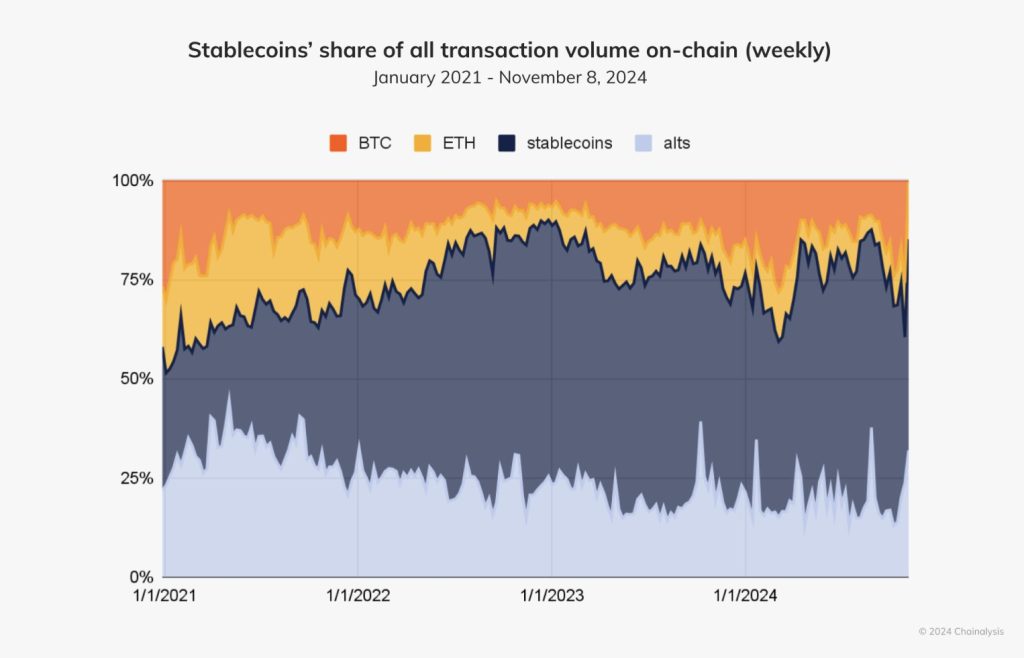
The real kicker shows up in the costs. Typical card acceptance lands around 1.5% to 3.5% per sale, while the World Bank still reports more than 6% to send $200 across borders. Demand rises anyway, and eMarketer projects U.S. crypto payers will grow by approximately 82 percent from 2024 to 2026, though off a small base.

Now zoom out to remittances, where minutes and cents matter. Remittance flows to low and middle-income countries reached roughly $656–669 billion in 2023 and are tracking toward about $685 billion in 2024, with the broader global total near $900 billion.
When a typical cross-border transfer still takes more than six cents on the dollar, cutting time and fees isn’t a feature request–it’s the job to be done.
The Path Forward
Ultimately, platforms face a clear choice — either keep optimizing for trading and serve a narrow audience, or evolve into utilities that deliver certainty to households and businesses.
The second path requires essential but less glamorous work: building redundancies, handling reconciliations and chargebacks, writing clear disclosures, and managing local payouts. While less visible, it builds lasting revenue and genuine customer loyalty.
Payments may not be the only use case for these networks, but it is the one that regulators already support and enterprises can adopt today. That is why card networks, banks, and on‑ramp providers now align around the idea of faster, safer settlement built on tokenized money. Follow the momentum that exists, then earn trust by making the experience simple and, honestly, a little boring.
Disclaimer: The opinions in this article are the writer’s own and do not necessarily represent the views of Cryptonews.com. This article is meant to provide a broad perspective on its topic and should not be taken as professional advice.
The post Forget Trading Charts, Crypto’s Real Future is Boring Payments appeared first on Cryptonews.